

The Column
Explaining Silyl Ether Formation (SEF) in Supercritical Fluid Chromatography (SFC)
The Column
Explaining Silyl Ether Formation (SEF) in Supercritical Fluid Chromatography (SFC)


The Column
Researchers at the University of Pardubice in the Czech Republic have developed a high-throughput ultrahigh-performance supercritical fluid chromatography–mass spectrometry (UHPSFC–MS) method that can analyze lipidomic samples in as little as 6 min.
The Column
Click the title above to open The Column July 09, 2015 Europe & Asia issue, Volume 11, Number 12, in an interactive PDF format.
The Column
Click the title above to open The Column July 09, 2015 North American issue, Volume 11, Number 12, in an interactive PDF format.
The Taipei’s Chang Gung University (CGU) Healthy Aging Research Center has joined the Waters Centers of Innovation (COI) Program as a partner, making it the first in Taiwan to do so.
High fat content of foods has been a problem when analyzing samples for nonpolar contaminants such as pesticides, PCBs, and PAHs. Extraction methods for these compounds tend to generate samples that are highly contaminated with fatty matrix, causing a number of problems with the subsequent chromatographic analysis. Traditional cleanup techniques, such as gel permeation chromatography (GPC) and normal phase column chromatography can be very effective, but are often expensive and time consuming. In this seminar, we will present an alternative approach to the cleanup of fats using a novel zirconia-based family of sorbents, for both QuEChERS (dispersive SPE) and traditional cartridge SPE.

E-Separation Solutions
If you use SPE in your work, then most likely it’s very important to the success of your applications and it’s proper implementation will be key to the performance of your analyses. However, SPE protocols are “variable in quality” (I’ve been as I kind as I can there!) and this variability appears to come from some common issues, misunderstandings and, frankly, ignorance of the mechanisms which are in play.
The Column
LCGC Blogger Tony Taylor presents his eight steps for improving your solid-phase extraction (SPE) results.

LCGC Europe
LC Determination of Residual Primary Amine Content in Epoxy-Amine Adducts

LCGC Europe
What are possible causes for distortion of the first two peaks in a chromatogram?

LCGC Europe
As flame ionization detection (FID) approaches its 60th anniversary in 2017, this instalment examines the crucial role that it has played and continues to play for all types of gas chromatography (GC). Without FID, the early development of GC would have proceeded more slowly, especially in the petroleum industry and related hydrocarbon application areas.
LCGC Europe
The 10th Balaton Symposium on High‑Performance Separation Methods will be held on 2–4 September 2015 at the Hotel Azúr in Siófok, Hungary. The biannual Balaton Symposium has grown to be one of the most important events of the separation science field in central Europe, bringing together separation scientists and friends from all over the world. The symposium is designed to discuss the latest issues, current requirements, and technological challenges faced in the present and the future. Twenty years after the first Balaton Symposium, the Hungarian Society for Separation Sciences continues the tradition.

LCGC Europe
An excerpt from LCGC’s e-learning tutorial on gradient HPLC at CHROMacademy.com

Special Issues
We present a brief review of this year’s ASMS conference, which took place May 31–June 4, 2015, in St. Louis, Missouri.
Special Issues
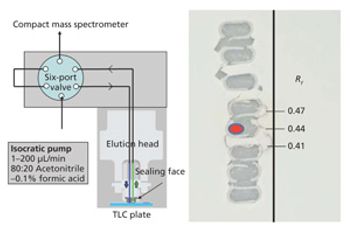
Compact mass spectrometry, in combination with suitable sample introduction techniques-such as the atmospheric solids analysis probe, thin-layer chromatography, and classical liquid chromatography techniques-can be used effectively for the detection and quantification of cannabinoids and pesticides in cannabis-related material and contraband.
Special Issues
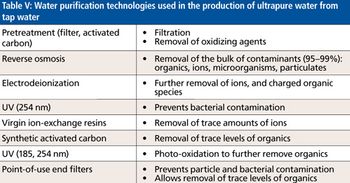
Ionic contaminants in the water used in UHPLC analyses with MS detection method lead to adduct formation and reduced analytical signals because of ion suppression. In MS, the preferred ion type is the protonated molecular ion, especially in peptide analysis, since the partially mobile proton charge enables more meaningful fragmentation analysis, as compared to a sodiated peptide ion. Moreover, the occurrence of protonated analyte signals indicates that solvents and reagents, as well as the MS instrument used in analyses, are clean and do not contribute any contaminating cationic components to the analytical process. In the experiments presented here, it was observed that the signal intensities of the protonated species decreased as the sodium ion concentration in the water increased. This was accompanied by an increase in the intensity of sodiated adducts.

LCGC North America
The CEToolbox app is designed as a calculator for capillary electrophoresis.

The Application Notebook
This application note demonstrates the comprehensive 2D-LC analysis of different types of beer. Nontargeted, multisample analysis (fingerprinting analysis) enabled a classification of the different types of beer analyzed.
The Application Notebook
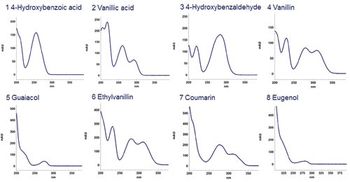
This application note presents a gradient method using a core–shell column for the determination of various substances in Bourbon vanilla extracts as well as in natural and artificial vanilla flavours. The aim is to compare the ingredients to achieve proof of the authenticity of Bourbon vanilla. By applying the Knauer AZURA Analytical system, a very short analysis time and low eluent consumption could be achieved. The high speed and reliability of the method makes it well-suited for routine analyses in food control.
The Application Notebook
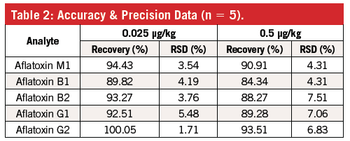
Aflatoxins (B1, B2, G1, and G2) are naturally occurring mycotoxins produced by fungi on agricultural crops. They are classified as carcinogenic and can pose a significant risk to human health if consumed. Although aflatoxin B1 is the most potent carcinogen, the main concern in milk is its hydroxylated metabolite, aflatoxin M1. To ensure the safety of milk, the US FDA established a tolerance of 0.5 µg/kg for aflatoxin M1 in milk, while the EU set a limit of 0.05 µg/kg in raw milk and 0.025 µg/kg in infant formula. A simple and effective method using polymeric solid-phase extaction (SPE) and liquid chromatography coupled to tandem mass spectrometry (LC–MS–MS) is presented for the analysis of aflatoxins in milk at the low concentrations required.

The Application Notebook
Amino acids are of vital importance for human life. They serve as transport or storage media for metabolic pathways. Amino acids are components of protein-containing foods such as milk and milk products. Eight amino acids are thought to be essential for humans, meaning that they must be absorbed from foods containing animal proteins or a suitable combination of plant proteins, because the human body can’t synthesize them. Determination of the composition and content of amino acids in milk products is therefore an important measure in ensuring quality and nutritional value.
LCGC Europe
Click the title above to open the LCGC Europe July 2015 regular issue, Vol 28, No 7, in an interactive PDF format.
LCGC North America
Click the title above to open the LCGC North America July 2015 regular issue, Vol 33 No 7, in an interactive PDF format.
Special Issues
Click the title above to open the July 2015 issue of Current Trends in Mass Spectrometry, Volume 13, Number 3, in an interactive PDF format.

LCGC Europe
In this instalment, an overview of response surface methodology is presented and its application to developing extraction methods is discussed.
HSCTA
Ultra high resolution, accurate mass (UHRAM) mass spectrometry, based on the Thermo ScientificTM OrbitrapTM technology, is a powerful new approach to high throughput screening and quantitation in complex sample matrices. To learn more about how UHRAM is used in the Million Metabolome Project, an ambitious milestone for Exposome Research, LCGC talked with Dean Jones of Emory University.

Webster’s New Collegiate Dictionary defines a myth as “an ill-founded belief held uncritically, especially by an interested group.” Could that group be misinformed chromatographers? Find out by clicking through the slideshow.