

LCGC North America
Introducing the new Verity® 1900 MS Detector from Gilson. Find out how Gilson’s solution is allowing mass detection to move into the mainstream.
LCGC North America
Introducing the new Verity® 1900 MS Detector from Gilson. Find out how Gilson’s solution is allowing mass detection to move into the mainstream.
The Pharmaceutical Inspection Convention and Pharmaceutical Inspection Co-operation Scheme (jointly referred to as PIC/S) provide good manufacturing practice (GMP) guidance for the lifecycle of a product. The scope of this executive summary is to provide a brief high-level overview of GMP, the impact of PIC/S, and compliance with the PIC/S document PE 009-12 “Guide to Good Manufacturing Practice for Medicinal Products Annexes“ Annex 11 Computerized Systems.
LCGC North America
UCT’s approach for the analysis of anabolic steroids from serum utilizes a traditional reversed phase interaction, but also features the addition of strong-anion exchange functionality (QAX) within the sorbent. This added functionality aids in the removal of unwanted matrix components commonly found in serum such as amino acids and inorganic ions. To prove the effectiveness of this approach, a comparison study was conducted using UCT’s recommended sorbent for steroid analysis (C8 + QAX) versus a traditional SLE, diatomaceous earth sorbent.
LCGC North America
FMS, Inc. has a complete line of automated PLE solutions for extracting solids in your laboratory. Our Automated PLE solutions can improve the reproducibility of your analytical results, increase efficiency and save on operational costs, time and labor. To learn more about PLE applications for Environmental, Clinical and Food matrices. Download the Pressurized Liquid Extraction Notebook.
LCGC Europe
FMS, Inc. has a complete line of automated PLE solutions for extracting solids in your laboratory. Our Automated PLE solutions can improve the reproducibility of your analytical results, increase efficiency and save on operational costs, time and labor. To learn more about PLE applications for Environmental, Clinical and Food matrices. Download the Pressurized Liquid Extraction Notebook.
Data integrity problems in pharmaceutical quality control laboratories are driving more regulatory action than ever before. It is obvious that something has changed to drive all this activity. There is plenty of information available, but much of it seems to confuse or frustrate rather than clarify or help. In this whitepaper, we will provide clarity, dispelling confusion by looking at the facts, based on a study of available resources and direct interactions with FDA staff and their consultants. You’ll learn from Loren Smith, Agilent’s software compliance expert and a UC Berkeley instructor with 25 years of regulated software experience, how to put the current enforcement environment in historical context, and to apply critical thinking skills to what you hear or read regarding data integrity. You’ll also learn how to evaluate your current laboratory software and associated processes against these new expectations, as well as how vendors are redesigning laboratory software to help you respond to these new realities.
The introduction of UHPLC revolutionized bio/pharma analytical laboratories and advances in technology promise more for the future. In this ebook, experts explain recent advances in UHPLC, and the basics of glycan analysis. Sample preparation technologies that can increase sample throughput and improve data quality for peptide quantitation are explored. In addition, the characterization of intact antibodies using reversed-phase chromatography is detailed. Review UHPLC workflows for: • Glycan analysis • Peptides • Monoclonal antibodies
As instrumentation and analytical methods are becoming increasingly sensitive, the ability to perform trace and ultra trace analyses relies on the high quality and purity of the reagents used.
Chromatographers take great care in the selection of salts and organic solvents used in mobile phase preparation, but selecting the best type of water is sometimes an arduous task.
Ultrapure water is highly prone to contamination, e.g. it easily leaches contaminants out of container surfaces and absorbs contamination from the laboratory environment. As ultrapure water is the most frequently used solvent in any LC-MS laboratory, its purity plays a critical role in analyses. There are a number of high purity water handling pitfalls that result in degradation of its quality. To help analysts critically evaluate the potential risks involved in poor ultrapure water handling, we discuss here (I) the effect of laboratory environment and long high purity water storage, (II) the effect of the container material used to collect ultrapure water, (III) the effect of laboratory ware and equipment cleaning, and (IV) the effect of poor practices of water purification system usage.
As the sensitivity of analytical instrumentation is constantly improving, and ultra-traces of compounds are being analyzed, the purity of reagents is becoming of paramount importance. Trace impurities in the water used to prepare LC-MS mobile phases, standards or blanks may lead to erroneous results or difficulties in analyzing data.
LCGC Europe
‘Old’ HPLC methods with long run times are being altered or surpassed by newer UHPLC or core-shell methods in order to save time and cost. In this application note we show how with the use of 3 simple equations transfer of older methods can be easily achieved onto newer core-shell particles. We show the example of a pharmaceutical drug and its impurities being reduced from a 30minute run time down to less than 10minutes. Using the calculations correctly means that no loss of resolution is seen even with the decrease in retention time.
LCGC North America
‘Old’ HPLC methods with long run times are being altered or surpassed by newer UHPLC or core-shell methods in order to save time and cost. In this application note we show how with the use of 3 simple equations transfer of older methods can be easily achieved onto newer core-shell particles. We show the example of a pharmaceutical drug and its impurities being reduced from a 30minute run time down to less than 10minutes. Using the calculations correctly means that no loss of resolution is seen even with the decrease in retention time.
LCGC Europe
Starch is used for a variety of industrial and nu¬tritional purposes. Its functional properties are influenced by the ratio and molar masses of its mac¬romolecular constituents, which vary with source, crop year, and climate. Starch contains large homopolymers of amylose (AMY) and amylopectin (AMP).
The Application Notebook
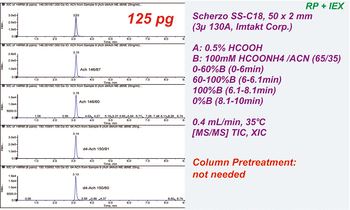
In the example shown here we seek to provide an alternative to HILIC methods by using a novel multi-mode column called the Scherzo SS-C18. This stationary phase has both reversed phase (C18) and polar components with the addition of a high density of strong anion and cation exchange ligands. This strategy for increasing polar retention is much more predictable run to run and does not require lengthy column pre-treatments.
LCGC North America
Size exclusion chromatography (SEC) is widely used for detecting aggregates, fragments, and other impurities in a biotherapeutic sample. When coupled with multi-angle light scattering (MALS), SEC enables researchers to quantify the true solution molar mass of each species in a sample, in addition to the mass fraction of each spe-cies.
LCGC Europe
Multi-angle light scattering (MALS) is primarily used to determine molecular weight, size-and shape-related parameters of macromolecules or nanoparticles as they elute from a separation device. In batch (unfractionated) mode, MALS provides the weight-average molecular weight wand the z-average mean square radius z. The DAWNHELEOSIIis particularly well suited for these tasks owing to its flow cell design, holding a mere ~67µl and readily connecting toa fluid line through HPLC-type fittings.
LCGC Europe
The dioxin family consists of 210 compounds, of which 17 contain the 2,3,7,8 pattern of chlorination. These 2,3,7,8 containing compounds are of extreme human health concern due to their high level of toxicity. Approximately, 12 of the 209 polychlorinated biphenyls have also been identified as human toxins. For this reason, the US FDA and EU have established strict regulations for the monitoring of food products for human consumption, in particular edible oils. Manual extractions of oils can be a time consuming procedure often delaying lab turnaround times. By automating the process with the EconoPrep®, food oil samples can be reliably processed with routine 24 hr turnaround times.
LCGC North America
The dioxin family consists of 210 compounds, of which 17 contain the 2,3,7,8 pattern of chlorination. These 2,3,7,8 containing compounds are of extreme human health concern due to their high level of toxicity. Approximately, 12 of the 209 polychlorinated biphenyls have also been identified as human toxins. For this reason, the US FDA and EU have established strict regulations for the monitoring of food products for human consumption, in particular edible oils. Manual extractions of oils can be a time consuming procedure often delaying lab turnaround times. By automating the process with the EconoPrep®, food oil samples can be reliably processed with routine 24 hr turnaround times.
LCGC North America
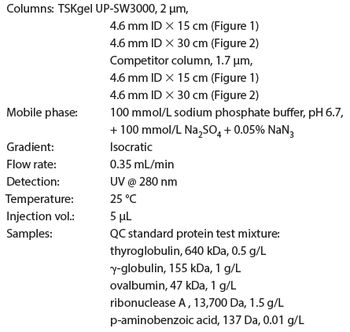
This note describes the use of TSKgel UP-SW3000, 2µm SEC columns for the analysis of proteins, with data demonstrating the operation of these columns using a simple and well established method for use in both HPLC and UHPLC systems. TSKgel UP-SW3000 columns have superior resolution for proteins and the shorter column dimension, 4.6 mm ID × 15 cm, allows runs to be completed 2 times faster than its longer column dimension counterpart without compromising resolution and reproducibility.
LCGC Asia Pacific
Centrifugal Partition Chromatography (CPC) also known as Counter Current Chromatography (CCC) is a preparative, pilot and industrial liquid purification technique that does not require traditional solid supports. CPC was used to purify few mg of gingerol from crude extract.
Special Issues
TSKgel UP-SW3000 columns are 2 µm SEC columns designed for the analysis of monoclonal antibodies and other biopharma products. Higher resolution can be achieved for the separation of antibody monomers, dimers, and higher order aggregates with a TSKgel UP-SW3000 column compared to a competitor UHPLC column. The TSKgel UP-SW3000 column provided excellent reproducibility for the peak parameters of retention time, asymmetry, and column efficiency. As demonstrated by the %RSD values, injection-to-injection reproducibility was superior to the competitor column.
The Application Notebook
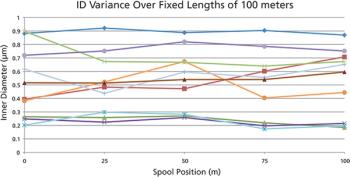
Scientists employ fused silica capillary tubing routinely in a wide range of analytical applications, encompassing GC, CE, capillary LC, and CEC. It has proven as an ideal substrate for interfacing in hyphenated techniques.

The Application Notebook
Due to the highly polar nature of saccharides, the analysis of sugars is typically achieved using hydrophilic interaction chromatography (HILIC).
The Application Notebook
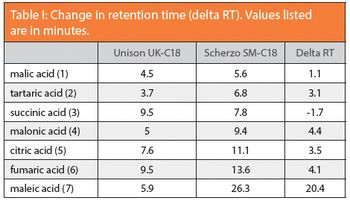
The challenging retention of polar organic acids in reversed phase conditions is accomplished using a unique multi-mode stationary phase.

The Application Notebook
Reflectron lenses are used in time-of-flight (TOF) mass spectrometers to create an electrostatic field to alter ion flow, providing for a longer flight path and therefore greater resolution.

The Application Notebook
Direct exposure probe (DEP) coupled to the Pegasus HT, time-of-flight mass spectrometer, was used for the identification of synthetic cannabinoids in MTN-series compounds.
The Application Notebook
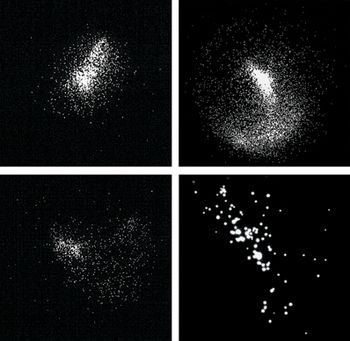
Photonis has combined two of our superior detection and analysis technologies into a new digital ion beam profiling unit. The new Ion Beam Profiler combines a large microchannel plate (up to 120 mm) in a complete assembly with the Photonis Nocturn, a high-resolution digital CMOS low-light camera which is immune to sudden light damage.

The Application Notebook
Silica-based cyano stationary phases have historically exhibited poor stability and short column lifetime at pH extremes. This application note details an investigation of the stability of YMC's Cyano-HG (high strength) 10 ?m silica-based stationary phase, which was performed at a customer's request.
Sponsored Content - EU
In water samples, OCPs are monitored by the U.S. Environmental Protection Agency by various methods including methods EPA 508, EPA 608, and EPA 8081. The use of solid phase extraction (SPE) can rapidly increase both extraction efficiency and reduce lab solvent usage. By implementing the FMS TurboTrace® ABN system with its dual cartridge functionality, an in-line Florisil cartridge can be added to perform automated extract clean-up during the elution step.