

The Application Notebook
The unique surface chemistry of the Flare diamond core-shell column combines ionic and hydrophobic separation mechanisms to effectively retain a variety of chemical species in a single run.
The Application Notebook
The unique surface chemistry of the Flare diamond core-shell column combines ionic and hydrophobic separation mechanisms to effectively retain a variety of chemical species in a single run.

The Application Notebook
Natural and synthetic phenolic compounds have been used in a wide range of applications, from antiseptics and fungicides to food additives.

The Application Notebook
In mass spectrometry instrumentation, the sensitivity and resolution of the instrument is often limited by the detector.
The Application Notebook
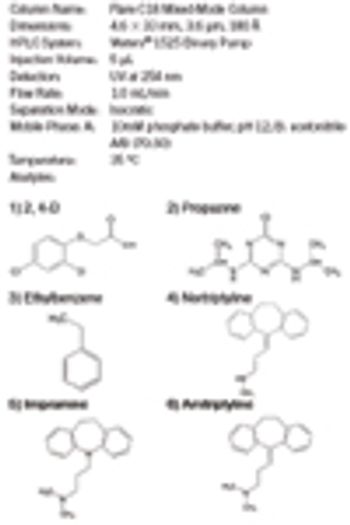
The unique surface chemistry of the Flare diamond core-shell column combines ionic and hydrophobic separation mechanisms to effectively retain a variety of chemical species in a single run.

The Application Notebook
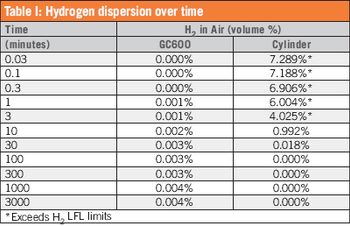
As the cost of helium increases and its availability decreases, an increasing number of Gas Chromatography (GC) professionals are considering switching to hydrogen gas for their carrier gas.

The Application Notebook
In mass spectrometry instrumentation, the sensitivity and resolution of the instrument is often limited by the detector.

The Application Notebook
Wyatt Technology Corporation
The Application Notebook
Agilent Technologies Inc.
The Application Notebook
Polymicro Technologies, a subsidiary of Molex Inc.
The Application Notebook
PHOTONIS USA, Inc.
The Application Notebook
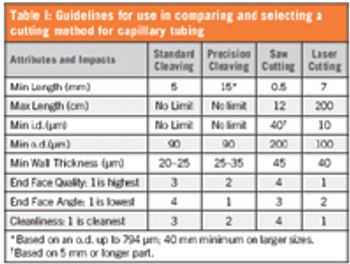
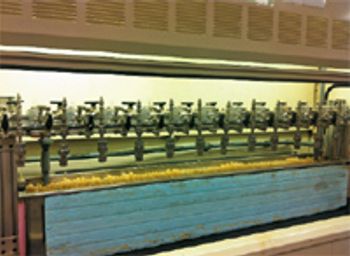
Polyimide coated fused silica capillary tubing is widely used in the separation sciences. In this application note, we share perspectives on modifying the internal surface of capillary tubing.

The Application Notebook
H2 is commonly used as GC carrier gas as the cost of He is increasing and its availability is decreasing. In addition to the cost/availability issues, H2 can provide more rapid separations at lower temperatures than He and provides longer column life. H2 gas is obtained by the electrolysis of water and many laboratories supply it to the GC via an in-house H2 generator.
The Application Notebook
Imtakt USA
The Application Notebook
PHOTONIS USA
The Application Notebook
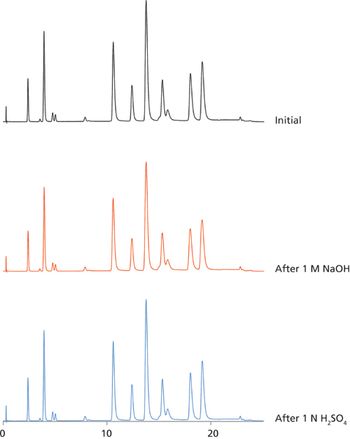
The Hamilton PRP-C18 is a new column designed to provide high-efficiency reversed phase separations over an extended column life in nearly any mobile phase or pH. The rigid stationary phase has excellent mechanical and thermal stability (> 100 ?C), does not experience shrinkage or swelling and is completely inert to most conditions commonly encountered in reversed phase chromatography. In this study the pH stability of the PRP-C18 is evaluated. Even after prolonged exposure to concentrated (1 molar) NaOH and H2SO4 there was no measurable deterioration in performance.

Special Issues
Hamilton Company

The Application Notebook
Ion mobility spectrometry (IMS) has become widely accepted for the detection of chemical warfare agents, explosives, and narcotics as well as for pharmaceutical quality control and pesticide screening of food. Most currently available commercial IMS units have a resolving power of 10–60.

The Application Notebook
Polyimide coated fused silica capillary tubing is widely used in the separation sciences. In some instances a condition called brittleback can appear in the tubing. Its causes and remedies are discussed.
The Application Notebook
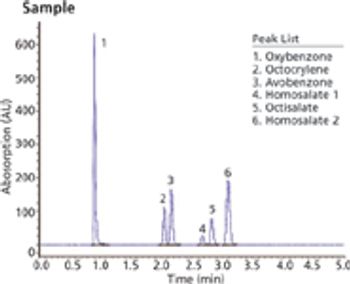
The FDA has made changes to how products containing sunscreen are labeled in the U.S. to ensure they meet the new regulations set forth for safety and effectiveness. The new regulations will require companies that want to use the "broad spectrum" label to test for both UVA and UVB protection.
The Application Notebook
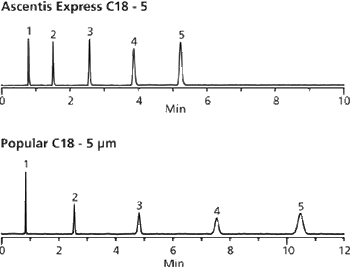
Ascentis Express 5 micron columns provide a new choice for improving the performance of traditional HPLC systems. Based on Fused-Core particle technology, Ascentis Express provides the benefits of high speed and high efficiencies without the concerns of smaller particle columns. Due to the high efficiencies at low backpressures, Ascentis Express 5 micron can benefit conventional HPLC users with no drawbacks.

The Application Notebook
The efficiency of ion transfer between the quadrupole mass analyzers and the Q2 collision cell in a triple quadrupole mass spectrometry (MS) is critical for instrument robustness and sensitivity. Q2 is a radio frequency (RF) only non-mass filtering quadrupole containing only an inert collision gas such as Ar, He, or N2 to provide collision induced dissociation of the precursor ion selected in Q1.
The Application Notebook
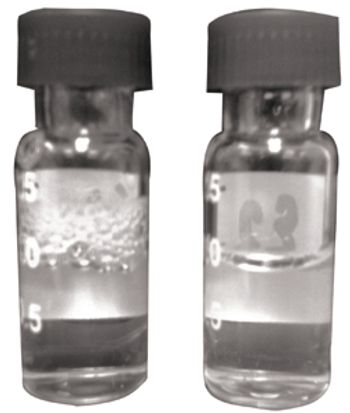
When working with complex matrices such as personal care products, sample preparation is perhaps the most difficult step of the analysis process. By utilizing a targeted sample preparation technique, such as ion-exchange SPE, analysis can be significantly improved as compared to less targeted techniques such as liquid-liquid extraction.
The Application Notebook
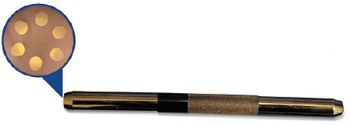
Resistive glass tubes and plates are designed to guide ions by generating a uniform electric field. Photonis resistive glass products are composed of a proprietary lead silicate glass that has been specially processed to create a resistive layer at the surface. The resistivity can be varied over several orders of magnitude to suit the specific application.

The Application Notebook
GCxGC-TOFMS provided a comprehensive analysis of tobacco smoke. Individual smoke constituents across several target compound classes were extracted, chromatographically resolved, then identified and quantified with mass spectral detection.
The Application Notebook
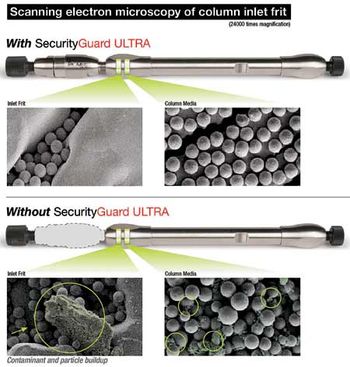
UHPLC columns can significantly improve chromatographic separations, but they also present unique challenges. Once the UHPLC system components are optimized, perhaps your greatest concern is protecting the column from the damaging effects of microparticulates and sample contaminants.

The Application Notebook
Synthetic fused silica capillary tubing is used in the manufacture of most gas chromatography (GC) columns. In this note, we discuss recent advances in the dimensional control of the most popular tubing sizes.
The Application Notebook
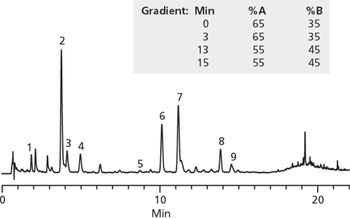
Silymarin, derived from the milk thistle plant, has been used as a natural remedy for the treatment of a number of liver diseases as well as in the protection of the liver from potential toxins. More recently, silymarin has been connected to antitumor promoting activity (1). It is therefore of interest to have available analytical methods for the analysis of silymarin components in various matrices.
The Application Notebook
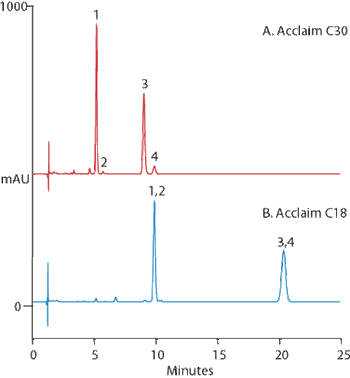
Vitamin K is a group of structurally similar, fat-soluble vitamins that are needed for the post-translational modification of certain proteins, mostly required for blood coagulation but also involved in metabolic pathways in bone and other tissue.

The Application Notebook
According to law enforcement and health officials, "bath salts" are powerful synthetic stimulants, designed to be comparable in effect to cocaine or methamphetamine, carrying similar risks. Unlike cocaine or methamphetamine, these stimulants are currently legal in many parts of the United States and available at a low cost in many convenience stores and head shops.