Application Notes: General

i4-589506-1408652624037.jpg

The Application Notebook

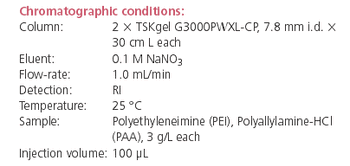
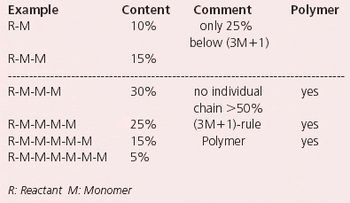
Under the registration, evaluation and authorization of chemicals (REACH) Regulations (EG) no. 1907/2006 the producer, manufacturer or importer of chemical substances/formulations have to register their products (more than 1 ton/year) at the chemical agency.

i4-589509-1408652617370.jpg

The Application Notebook

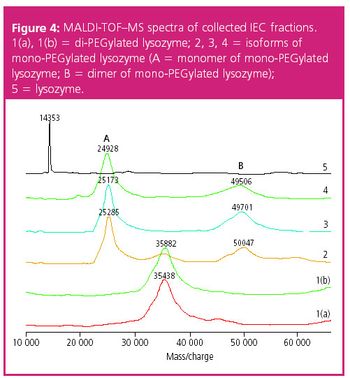
PEGylation, the process by which polyethylene glycol (PEG) chains are attached to protein and peptide drugs is a common practice in the development of biopharmaceuticals to prolong serum half-life and improve pharmacokinetics of a drug. There is increasing demand for chromatographic methods to separate the modified isoforms from the native protein. This application note describes the use of size exclusion and ion exchange chromatography for the characterization of PEGylated lysozyme.

i4-547967-1408670460995.jpg

The Application Notebook

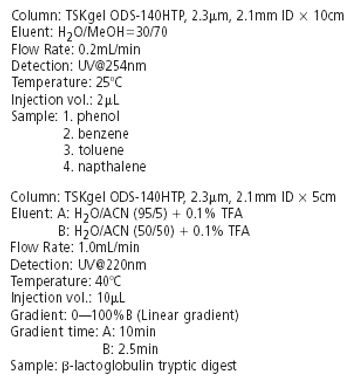
Short analyses time and high resolution are in great demand from R&D and QC departments within the pharmaceutical industry. Sub-two micron ODS reversed phase columns have recently been introduced to meet these requirements, but these columns require an ultra-high pressure HPLC system to achieve optimum performance. TSK-GEL ODS-140HTP, 2.3mm columns from Tosoh Bioscience have been developed to offer a combination of short analyses time and high resolution separations that can be run at modest pressures, making these columns compatible with conventional HPLC instrumentation. The polylayer bonding chemistry of these columns results in highly efficient and physically stable columns when operated at high linear velocities. In addition, TSK-GEL ODS-140HTP, 2.3mm columns can be efficiently operated at pressures not exceeding 9000psi in UPLC® and other ultra-high pressure HPLC systems, as well as in traditional HPLC systems.

i3_t-547883-1408670601496.jpg

The Application Notebook

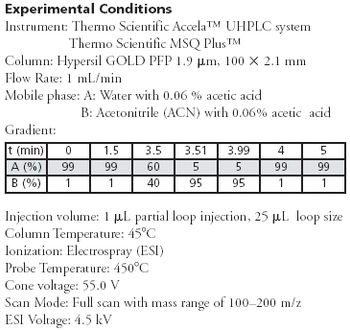
There are many misconceptions about what it means to perform fast gas chromatography (GC) and what the term fast GC implies. Fast GC is often associated with the use of hydrogen as a carrier gas and, although this is certainly a good approach, it is not always necessary to shorten the analysis time. A second misconception is that changing column dimension results in time-consuming method development. Using high-efficiency GC columns can greatly reduce the analysis time and when coupled with the method translation software, the time spent on method development can be greatly minimized.

i1_t-547878-1408670614559.gif

The Application Notebook

Viscotek has been a strong advocate of good chromatography as a prerequisite for GPC (Gel Permeation Chromatography) data accuracy. Our recent work in application development has been driven by extremely difficult samples from industrial, biopharmaceutical, and academic sources. These samples present challenges ranging from sample solubility, column adsorption as well as detection issues. This report will attempt to highlight a new approach that could be very helpful in certain advanced GPC applications.

i4-547885-1408670595145.jpg

The Application Notebook

The use of mobile phase pH to control analyte ionization states (pH-LCâ„¢) in reversed phase HPLC separations is a highly effective way to change selectivity. The ionized species of an analyte is shown to have higher polarity (less hydrophobicity) than the neutral species, which results in a loss of expected retention for that analyte. This can be attributed to less interaction with the hydrophobic stationary phase and greater affinity with the aqueous portion of the mobile phase. Ionized species also participate in ionic interactions with exposed and activated silanols, which impact peak shape and reproducibility.

i4-547966-1408670464057.jpg

The Application Notebook

Size exclusion chromatography is a powerful tool for the characterization of molecules differing in size and molar mass. It is widely used and well known for the determination of molar mass distributions and molar mass averages. For membranes GPC-SEC is a useful characterization method as it can measure the membrane characteristic pore size distribution, average pore size and molecular cut-off significantly faster than other methods.

i3-547858-1408670680434.gif

The Application Notebook

In the last few decades, the novel functions of polysaccharides have provided a major impetus for increasing scientific attention. Among the most promising aspects are their immunomodulatory and antitumor effects, thickening agents and stabilizer effects.

i1-547884-1408670599245.jpg

The Application Notebook

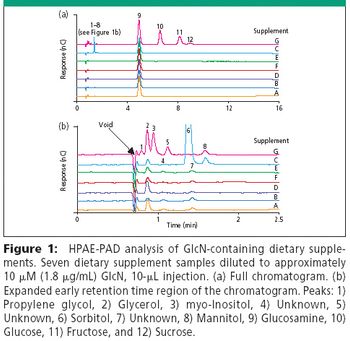
Glucosamine (GlcN) is a major structural component in the biosynthesis of glycosaminoglycans, compounds involved in normal joint function. Use of GlcN as a dietary supplement in the management of osteoarthritis has attracted considerable attention; it is one of the five nonvitamin, nonmineral supplements most frequently used by US adults (1). The US FDA currently regulates dietary supplements to ensure that they are produced under cGMP (2).

i2-547853-1408670694139.gif

The Application Notebook

Urea is commonly used in protein purification, including large-scale purification of recombinant proteins for commercial purposes, and in recombinant protein manufacturing to denature and solubilize proteins (1). In aqueous solutions, urea degrades to cyanate and ammonium, with the maximum degradation rate occurring at neutral pHs commonly used in biological buffers (2). Cyanate is problematic in urea solutions because it carbamylates proteins, which causes unwanted modifications that can alter the protein's stability, function, and efficiency. Therefore, an accurate, sensitive method for determining cyanate in urea-containing buffers is required.

i1-547857-1408670682295.jpg

The Application Notebook

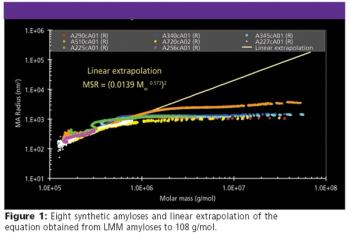
Amylose is an occasionally-branched biopolymer and, together with amylopectin, the hyper-branched component, a constituent of starch. Determination of branching in amylopectin on the basis of amyloses may be performed with the help of synthetic amyloses. Synthetic amyloses from enzymatic (phosphorolytic) reaction were checked for their linearity.