Application Notes: General

i3-547858-1408670680434.gif

The Application Notebook

In the last few decades, the novel functions of polysaccharides have provided a major impetus for increasing scientific attention. Among the most promising aspects are their immunomodulatory and antitumor effects, thickening agents and stabilizer effects.

i1-547884-1408670599245.jpg

The Application Notebook

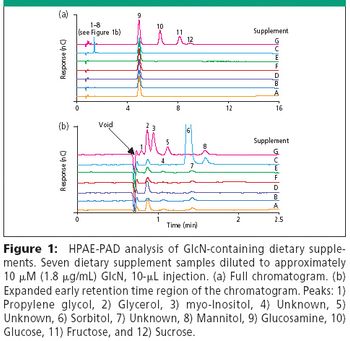
Glucosamine (GlcN) is a major structural component in the biosynthesis of glycosaminoglycans, compounds involved in normal joint function. Use of GlcN as a dietary supplement in the management of osteoarthritis has attracted considerable attention; it is one of the five nonvitamin, nonmineral supplements most frequently used by US adults (1). The US FDA currently regulates dietary supplements to ensure that they are produced under cGMP (2).

i2-547853-1408670694139.gif

The Application Notebook

Urea is commonly used in protein purification, including large-scale purification of recombinant proteins for commercial purposes, and in recombinant protein manufacturing to denature and solubilize proteins (1). In aqueous solutions, urea degrades to cyanate and ammonium, with the maximum degradation rate occurring at neutral pHs commonly used in biological buffers (2). Cyanate is problematic in urea solutions because it carbamylates proteins, which causes unwanted modifications that can alter the protein's stability, function, and efficiency. Therefore, an accurate, sensitive method for determining cyanate in urea-containing buffers is required.


i1-547857-1408670682295.jpg

The Application Notebook

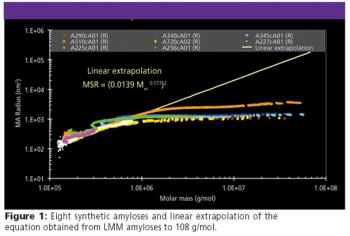
Amylose is an occasionally-branched biopolymer and, together with amylopectin, the hyper-branched component, a constituent of starch. Determination of branching in amylopectin on the basis of amyloses may be performed with the help of synthetic amyloses. Synthetic amyloses from enzymatic (phosphorolytic) reaction were checked for their linearity.

i1-479360-1408664989331.jpg

The Application Notebook

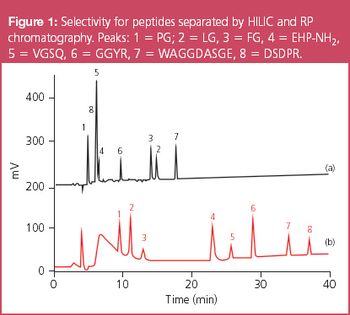
The analysis of polar compounds in support of clinical and pre-clinical pharmacokinetic studies requires an analytical methodology capable of achieving ultra-low detection and quantification limits. The high sensitivity afforded by coupling HPLC with tandem mass spectrometry (MS–MS) has made it the technique of choice in this environment, but it is subject to the following limitations when reversed phase liquid chromatography (RPLC) is used

i2-479064-1408665265313.gif

LCGC Asia Pacific

Multidimensional liquid chromatography (MDLC) techniques are essential for the separation of highly complex proteomic samples. Advantages of off-line MDLC techniques over on-line approaches include high flexibility in choice of column dimensions and mobile-phase compositions, and the ability to reanalyse sample fractions. Here we present a fully automated off-line two-dimensional chromatographic approach for the analysis of proteomic samples using an UltiMate 3000 system optimized for proteomics MDLC.

i4-479063-1408665267587.jpg

LCGC Asia Pacific

Combining an ultra fast LC system (e.g., Agilent 1200RRLC, Waters UPLC) with an accurate mass TOF mass spectrometer creates a powerful system for information-rich high-throughput analyses. However, for de novo formula generation and confirmation the residual mass accuracy tolerance of 3–5 ppm can still leave significant ambiguity in the proposed formula. Consequently, skilled manual inspection or further measurements deploying additional analytical techniques (NMR or MS–MS) are frequently required to arrive at a confident formula assignment.