

The Application Notebook
Achieve highly reproducible cIEF separations of basic mAbs using the basic pH gradient cIEF separation method on the PA 800 Protein Characterization System.
The Application Notebook
Achieve highly reproducible cIEF separations of basic mAbs using the basic pH gradient cIEF separation method on the PA 800 Protein Characterization System.
The Application Notebook
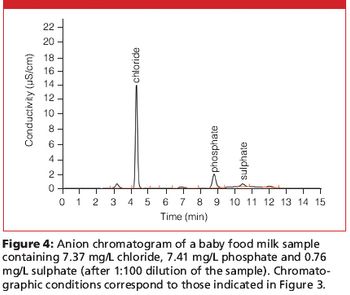
Run a difficult food sample on your IC and you stand a big chance that you will wreck the column. Of course, you can waste a lot of time on tedious sample preparation steps to eliminate undesired matrix components. Or you can go for Metrohm's automated compact stopped-flow dialysis providing optimum separation while protecting your column from detrimental compounds.
The Application Notebook
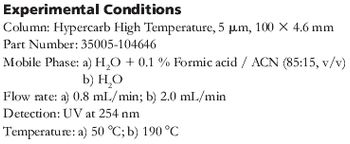
Increased temperature has been used to assist the elimination of organic modifier required in the mobile phase, to achieve analyte separation in pure aqueous mobile phases.
The Application Notebook
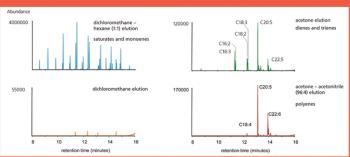
LC–GC approaches to analysis are particularly attractive because they combine the selectivity of solid phase sorbents in the first dimension with the separating power and peak capacity of a capillary GC column in the following dimensions. Their widespread use is limited because of the difficultly in desolvating the stream from the LC dimension without the solvent vapour passing down the GC column in significant quantity. An alternative approach to elution chromatography in the first dimension is to harness the specificity of the solid-phase process for digital chromatography using discontinuous changes in solvent polarity. Digital chromatography on a small sorbent bed reduces the volume of mobile phase to discrete plugs that are sufficiently small to be injected directly into a GC with a large volume injector or, alternatively, subsampled into a conventional split/splitless injector.
The Application Notebook
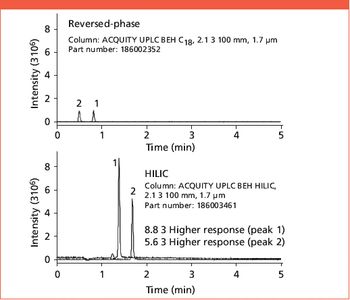
Using HILIC with highly efficient ethylene bridged hybrid (BEH) particles results in faster methods that exhibit improved polar retention, higher sensitivity, enhanced chromatographic resolution, and significantly improved column lifetime.

The Application Notebook
The global economic downturn, particularly the collapse of the automotive and associated industries, has caused an overall reduction in the demand for acrylonitrile. Since acetonitrile is obtained as a co-product in the production of acrylonitrile, the pharmaceutical, food, environmental, and chemical industries are experiencing an unprecedented acetonitrile shortage. This shortage has resulted in a sharp price increase, in some cases as much as 6-8 times; and the price is projected to remain high even after the production returns to normal.

The Application Notebook
Hydrogen, commonly used as a carrier gas instead of Helium for gas chromatography (GC) can be supplied via cylinders or by the electrolysis of water using an in-house generator containing metallic electrodes or an ionomeric membrane. An in-house generator can provide a significant increase in safety and convenience with a reduction in operating costs.

The Application Notebook
Hydroxyethylstarches (HES) are used increasingly as plasma expanders in medical applications. The HES' circulation time in the blood depends strongly on its molar mass distributions. Historically, polysaccharide characterization by Gel Permeation Chromatography (GPC) has been problematic, especially

The Application Notebook
Heparin is well-known as an anti-coagulant, antithrombotic drug. Chemically, it is a linear polysaccharide that is derived from animal tissues. For some time it has been known that heparin is not a homogeneous substance; rather, it is a heterogeneous mixture of molecules ranging in molar mass from less than 5,000 to more than 30,000 Daltons. Heparin can be chemically or enzymatically depolymerized to obtain low molecular weight (LMW) heparin products, which exhibit an improved pharmacological profile.
The Application Notebook
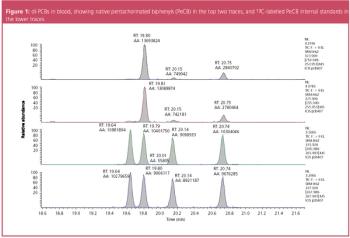
This application details a fast, reliable and highly selective trace-level screening method for the quantification of polychlorinated biphenyls (PCBs) in environmental, food and biological samples, using gas chromatography and a triple stage quadrupole mass spectrometer. The analytical strategy is analogous to the well-established US Environmental Protection Agency (USEPA) Method 1668A.
The Application Notebook
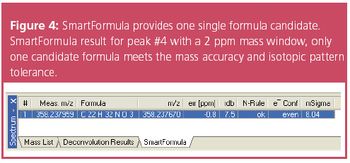
An ultrafast gradient LC separation method was developed to separate a 5-component drug mixture in 30 seconds, with peak widths of 1 second. maXis mass accuracy at sub-ppm levels and true isotopic pattern of the spectra from the peaks lead to a confident elemental formula assignment for each drug compound with the SmartFormula algorithm.

E-Separation Solutions
The success of evaporative light scattering detection relies on evaporating the eluent without destroying the analyte particle. Where the analyte is non-volatile, evaporator temperatures of 50-100 °C can be used without compound degradation, thus giving maximum sensitivity. However, when compounds have high vapor pressures and the eluent has a high boiling point (e.g. water), detection of semi-volatile compounds is problematic, because the evaporation temperature needs to be set at 30 °C or above in order to evaporate the solvent.

The Application Notebook
Improve the separation of 14 drugs of abuse in a complex mixture by employing a ternary solvent gradient.
The Application Notebook
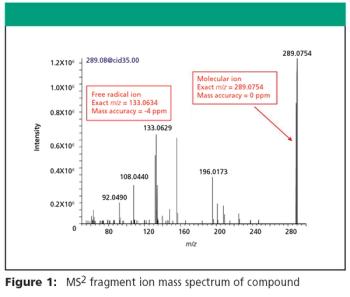
Studies of odd-electron CID behaviors reveal that free radical fragmentation is structure-dependent and is directly correlated with the functional groups that stabilize the newly-formed free radicals.
The Application Notebook
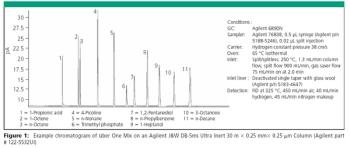
QC test probes serve a vital function in ensuring the reproducibility of modern GC columns. These probes ensure that the columns have been properly deactivated, contain the correct amount of stationary phase, and have the same relative retention as the last column purchased. The choice of individual compounds in these test mixes varies widely and can have profound consequences on the performance of a column in the users' applications.
The Application Notebook
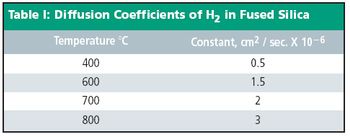
Synthetic fused silica capillary tubing is commonly used as the preferred substrate for chromatographic separation columns. In limited instances the absorption and diffusion of molecules into and through the fused silica deserves consideration.
The Application Notebook
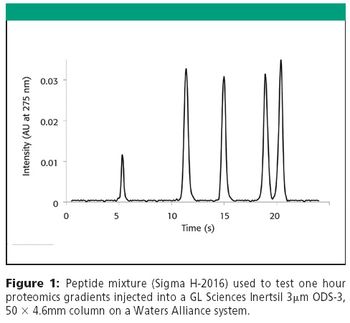
Transforming "standard" gradient HPLC systems into extremely fast gradient systems is readily achievable with proper application of chromatographic principles, particularly temperature control, combined with utilization of advanced HPLC columns. Bottom line: You don't have to buy a new LC to achieve ultra high quality and speed!
The Application Notebook
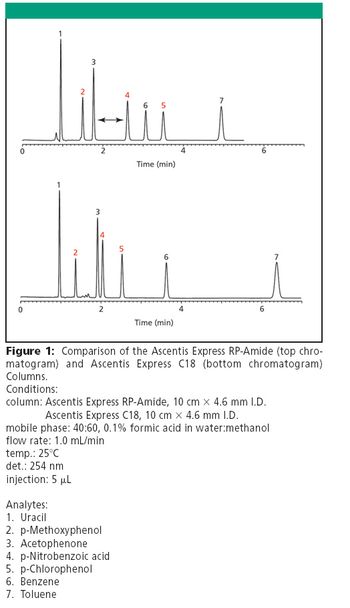
The Fused-Core particle consists of a 1.7 micron solid core and a 0.5 micron porous shell yielding a 2.7 micron diameter. One of the benefits of the Fused-Core particle is the small diffusion path (0.5 microns) compared to conventional fully porous particles. The shorter diffusion path minimizes peak broadening. In fact, there have been many reports on the vast improvements in efficiency provided by Fused-Core particles versus conventional particles. These improvements provide sub-2 micron like performance at half of the backpressure allowing Ascentis Express columns to be used in conventional HPLC as well as UHPLC systems.
The Application Notebook
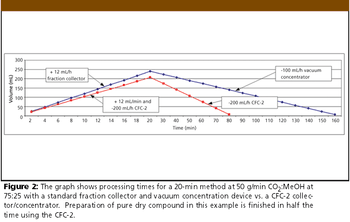
A novel centrifugal fraction collector CFCâ„¢ enables SFC users to simultaneously collect and concentrate fractions. The technique is particularly useful for chiral separations where large volumes of enantiomers are being purified by stacked injection methods.

The Application Notebook
In size exclusion chromatography, obtaining calibration curves over a wide range of molecular weights is a difficulty investigators often encounter when analyzing polymers with a broad molar mass distribution. To overcome this problem two procedures are typically used. One option is to use multiple columns of different pore sizes linked together in series. A second is to use a column packed with a mixed bed resin of different pore sizes at an optimized mix ratio. However, problems can occur with both of these methods, which include distortion of the chromatogram or deviations between the actual calibration curve and the calibration curve approximated from data obtained from the molecular weight standards.
The Application Notebook
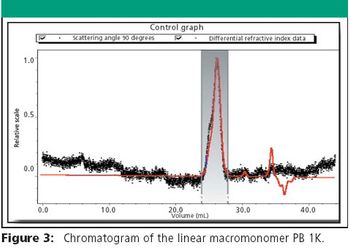
Our work focuses on the synthesis of branched (functionalized) polydienes via a facile two-step synthesis. Despite the numerous strategies developed for the preparation of branched polymers in recent years, there is still a limited number of simple synthetic strategies based on common vinyl monomers.
The Application Notebook
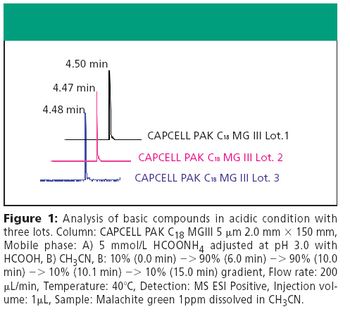
The SHISEIDO CAPCELL PAK C18 MGIII is an HPLC column packed with a silicone polymer-coated phase, providing excellent peak profiles for basic compounds under acidic conditions, and generating ultimately minimized column bleeding in LC–MS.

The Application Notebook
In general, polymer-based columns have a broad pH range (pH 2 to 13), and some have high temperature tolerance (up to 150°C or higher). Considerably large selectivity changes can be obtained by varying analysis temperature and mobile phase pH. Having control on these two parameters over wide ranges can be especially useful in method development.

The Application Notebook
Viscotek has been a strong advocate of good chromatography as a prerequisite for GPC (Gel Permeation Chromatography) data accuracy. Our recent work in application development has been driven by extremely difficult samples from industrial, biopharmaceutical, and academic sources. These samples present challenges ranging from sample solubility, column adsorption, as well as detection issues. This report will attempt to highlight a new approach that could be very helpful in certain advanced GPC applications.

The Application Notebook
Traditionally the analysis of water-soluble vitamins by reversed-phase HPLC has been complicated by the lack of retention for these compounds on conventional silica C18 columns. Here we demonstrate efficient, multi-mode, baseline resolution of six water-soluble vitamins in 6 min using a ZirChrom®-SAX column.

The Application Notebook
Amylose is an occasionally-branched biopolymer and, together with amylopectin, the hyper-branched component, a constituent of starch. Determination of branching in amylopectin on the basis of amyloses may be performed with the help of synthetic amyloses. Synthetic amyloses from enzymatic (phosphorolytic) reaction were checked for their linearity.

The Application Notebook
The analysis of polar compounds in support of clinical and preclinical pharmacokinetic studies requires an analytical methodology capable of achieving ultra-low detection and quantification limits. The high sensitivity afforded by coupling HPLC with tandem mass spectrometry (MS–MS) has made it the technique of choice in this environment, but it is subject to the following limitations when reversed-phase liquid chromatography (RPLC) is used

The Application Notebook
Capillary flow technology (CFT) devices are microfluidic components that extend capillary GC capabilities through simple and robust connections between pressure/flow modules and columns. One of the most powerful and simple is the CFT Tee. This is especially useful in GC–MS analysis providing (1) rapid column and inlet maintenance without MSD venting and (2) the capability of rapidly removing late eluting interferences from the column by forcing their retreat into the injection port through "backflushing". Removing these interferences improves column and detector longevity and analytical integrity. Backflushing is very valuable for trace GC–MS analysis in samples from complex matrices like soil, foods or tissues. The CFT Tee uses pressure-pulsed injections and constant flow mode with minimal loss in the MS signal. This approach will be useful to all GC–MS users who want to improve their instrument uptime.

The Application Notebook
An effective UHPLC–MS method for high throughput separation, identification and quantification of pseudoephedrine was developed on a Hypersil GOLD PFP 1.9 µm, 2.1 Ã- 100 mm column.
The Application Notebook
A new APCI/APLI source enables a high resolution TOF-MS to be coupled on LC and GC, thus increasing flexibility and performance of TOF-MS in combination with GC.