




A column with chemically modified column hardware showed improvements in analytical performance for siRNA compared to a conventional stainless-steel column.

The new General Chapter <621> does reflect the great work of the Pharmacopoeias in helping chromatographers to use more modern technology for their regulated methods, speeding up analysis, and reducing waste. The latest revision allows us to adjust column dimensions for gradient separations, which is a significant advance. Although these freedoms are welcomed, one must be very mindful of the requirements or limits of the allowable changes and the verification work that underpins our demonstration of equivalent performance of the adjusted method.
A column with chemically modified column hardware showed improvements in analytical performance for siRNA compared to a conventional stainless-steel column.

In this first TRLC instalment, our recent developments, new possibilities, and current limitations of the use of 1D TRLC are discussed, while the column performance is described with respect to the fundamentals of HPLC.

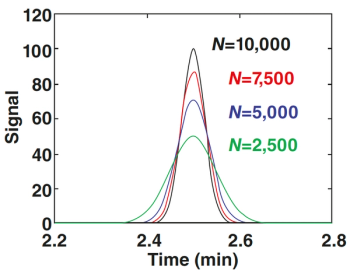
In this latest instalment of our series on recurring challenges in liquid chromatography (LC), we turn our attention to peak widths that are wider than expected. Estimating the expected peak widths can help determine when a column and LC system are not working quite right, and to decide when troubleshooting should be initiated.

This month we interview Martina Catani from the University of Ferrara, Italy, about her work on the separation of enantiomers by high performance liquid chromatography/ultrahigh-pressure liquid chromatography (HPLC/UHPLC) and the study of the kinetic and thermodynamic properties of chiral stationary phases, and the separation and purification using LC analysis (single-column and continuous multi-column) of biomolecules of high therapeutic interest.

Webcasts
Webinar Date/Time: Thursday, February 16th, 2023 at 8am PST | 11am EST | 4pm GMT | 5 pm CET

When considering different ways to improve an established LC method, it helps to start by reviewing some essential concepts.

Robots outperform humans in five areas, and thus can be particularly beneficial for performing sample preparation for HPLC.
A harmonization of all conventional hold-up volume methods was successfully applied to RPLC, HILIC, AEX, and RP-AEX mixed-mode chromatography, regardless of the mobile phase.
Developing a short list of the likely causes of these results can help streamline our troubleshooting experience when sensitivity-related problems occur.

Webcasts
Webinar Date/Time: Thu, Jan 19, 2023 11:00 AM EST

Quantifying the content of coumarin and cinnamaldehyde in cinnamon products

In this extended special feature to celebrate the 35th anniversary edition of LCGC Europe, key opinion leaders from the separation science community explore contemporary trends in separation science and identify possible future developments.

In this extended special feature to celebrate the 35th anniversary edition of LCGC Europe, key opinion leaders from the separation science community explore contemporary trends in separation science and identify possible future developments.

Estimating expected peak widths helps us determine when a column and LC system is not performing optimally.

In this extended special feature to celebrate the 35th anniversary edition of LCGC Europe, key opinion leaders from the separation science community explore contemporary trends in separation science and identify possible future developments.

TRLC can obtain separations similar to those of reversed-phase LC while using only water as the mobile phase.

In this extended special feature to celebrate the 35th anniversary edition of LCGC Europe, key opinion leaders from the separation science community explore contemporary trends in separation science and identify possible future developments.

The values determined by van’t Hoff analysis only have practical significance if we analyze the results obtained with well-planned and systematically varied experiments.

Learning or mastering new skills as an adult can feel daunting. These three tips will help.

In this extended special feature to celebrate the 35th anniversary edition of LCGC Europe, key opinion leaders from the separation science community explore contemporary trends in separation science and identify possible future developments.

In this extended special feature to celebrate the 35th anniversary edition of LCGC Europe, key opinion leaders from the separation science community explore contemporary trends in separation science and identify possible future developments.

Webcast
Webinar Date/Time: Mon, Dec 12, 2022 11:00 AM EST

Webcasts
Webinar Date/Time: Tue, Dec 13, 2022 11:00 AM EST

Webcasts
Webinar Dates/Times: Wednesday, December 14th, 2022 at 10am EST|3pm GMT Wednesday, December 14th, 2022 at 2pm EST|11am PST Thursday, December 15th, 2022 at 12pm JST|11am CST

Cover Story
The Column spoke to Brett Paull from the University of Tasmania in Hobart, Australia, about the development of truly portable LC systems for use in the pharmaceutical industry and in environmental analysis. Why are they necessary, and where can improvements still be made?