



LCGC North America
Re-equilibrating a reversed-phase stationary phase following aqueous gradient elution can be achieved much faster than you think.
LCGC North America
Re-equilibrating a reversed-phase stationary phase following aqueous gradient elution can be achieved much faster than you think.

LCGC North America
Liquid Chromatography and High-Resolution Mass Spectrometry In food analysis, HPLC and triple-quadrupole mass spectrometry are established techniques. Jon Wong of the Center for Food Safety and Applied Nutrition at the U.S. Food and Drug Administration discusses why his agency and others have been developing food analysis methods using UHPLC and HRMS.

LCGC North America
Dwight Stoll, who will take the reins of “LC Troubleshooting” next month, spoke with John Dolan to get some insight on the current state of chromatography with John Dolan to get some insight on the current state of chromatography training, future troubleshooting problems, John’s toughest troubleshooting challenge, and the most common chromatographic mistakes.
LCGC Europe
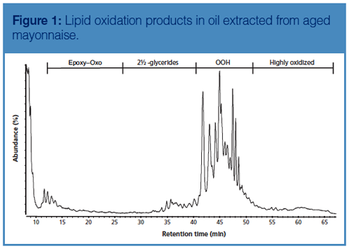
Monitoring lipid oxidation during the shelf life of lipid-containing food emulsions, such as mayonnaise, is challenging. It is, however, essential for the development of improved, consumer-preferred products. Determining the nonvolatile lipid oxidation products (NONVOLLOPS), the precursor compounds for rancidity, is required to determine the effectiveness of product stabilization technologies. A method based on normal-phase liquid chromatography with atmospheric pressure photo ionization-mass spectrometry (LC–APPI-MS) was developed for this purpose. The inclusion of a size-exclusion chromatography (SEC) step was needed to remove interfering diacylglycerides and free fatty acids from the samples. The combined SEC and normal-phase LC–APPI-MS method allowed the identification of a wide range of oxidized species including hydroperoxides, oxo-2½ glycerides, epoxides, and other oxidized species. The method was found to be more suitable for the analysis of large sample sets. The relative levels of NONVOLLOPS from bo

LCGC North America
Topics that stood out at HPLC 2017 include advances in large-molecule separations, multidimensional chromatography, HILIC, and chiral separations.
LCGC North America
When developing or modifying an LC separation, a common strategy is to change selectivity by choosing a new column. Here’s guidance for making that selection.

LCGC North America
This is an exciting time for 2D-LC, as the expanding community of users works to develop creative solutions involving 2D-LC to solve analytical challenges that are very difficult or impossible to solve by conventional means.

LCGC North America
Leading separation scientists share their perspectives on current challenges in separation science and where the field is heading.
LCGC North America
You have to be careful when adjusting gradient conditions.
LCGC North America
UHPLC’s benefits include fast analysis, high-resolution separations, reduced solvent and sample usage, enhanced sensitivity and precision, and more.

LCGC North America
A surfactant based diluent was used in sample preparation for reversed phase HPLC analysis of a drug product and its impurities in a phospholipid formulation. The use of the didodecyl trimethylammonium bromide (DDAB) enabled a consistent, quantitative extraction of the analytes of interest from the lipid matrix in a much more aqueous, weak solvent. Water was added as an anti-solvent to precipitate out the surfactant from the system to eliminate HPLC injection pressure spikes, enabling large volume injections and achieving a consistent, robust method for long term use. Method development and validation steps are described.

LCGC North America
Several variables can be used to change selectivity in a liquid chromatographic (LC) separation. Here we compare the variables in an effort to prioritize which experiments will be most effective.

Special Issues
A primary impediment to cannabinoid research is the fact that materials possessing psychoactive Δ-9-tetrathydrocannabinol are considered Schedule I drugs as defined in the U.S. Controlled Substances Act. An alternative source of cannabinoids may be found in hemp oil extracts. Hemp contains a low percentage of Δ-9-tetrathydrocannabinol (THC) by weight but relatively high amounts of non-psychoactive cannabinoids. The liquid chromatography-time of flight mass spectrometry (LC-TOF) method presented herein allows for the accurate, precise and robust speciation, profiling and quantification of cannabinoids in hemp oil extracts and commercial cannabinoid products for research and development laboratories. The method was determined to chromatographically separate 11 cannabinoids including differentiation of Δ-8-tetrahdrocannabinol and THC with excellent linear dynamic range, specificity and sensitivity.
LCGC North America
We’ll see how to find the “sweet spot” in terms of retention for a liquid chromatographic separation as well as how much retention change is to be expected for a selected change in mobile-phase percent organic or column temperature.
LCGC North America
This installment describes HPLC and related products introduced at Pittcon 2017 Chicago and in the year prior. It highlights new HPLC systems, modules, and software, with innovative features and significant benefits to the users.
LCGC North America
When considering column efficiency, more is not always better. We look at some ways to quickly estimate the effects of changes in column length and particle diameter rather than trying the experiments in the laboratory.

LCGC North America
Rudolf Krska, from the University of Natural Resources and Life Sciences in Vienna, Austria, talks about the latest analytical techniques and challenges facing analysts involved in the evolving field of mycotoxin analysis.
LCGC North America
Delivering samples to the analytical column in ‘clean’ mobile phase is important for robust methods and high quality results.

LCGC North America
The carotenoid test allows one to build a simple classification map of stationary phases used in reversed-phase liquid chromatography, on the basis of the shape recognition(plotted on the x axis) the polar surface activity(plotted on the y axis) and the phase hydrophobicity (related by the bubble size).

LCGC North America
There is increasing demand to analyze samples with a wide range of polarities, in fields such as environmental analysis and proteomics.

LCGC North America
We explore the careers and achievements of the winners of LCGC’s 10th annual awards: Pat Sandra and Deirdre Cabooter.
LCGC North America
A reader’s problem of a method that fails the repeatability of the system suitability test serves as an example of how to approach LC method troubleshooting.

LCGC North America
Part II of this series describes additional features of the HPLC Teaching Assistant software, including the possibility to simulate the impact of the mobile phase temperature on HPLC separations; understand the chromatographic behavior of a mixture of diverse compounds in both isocratic and gradient elution modes; show the influence of instrumentation (injected volume and tubing geometry) on the kinetic performance and sensitivity in HPLC; and demonstrate the impact of analyte molecular weight on thermodynamic (retention and selectivity) and kinetic (efficiency) performance.
LCGC North America
What could be causing a peak to be eluted before the column dead time? In last month’s “LC Troubleshooting” (1) we looked at problems two readers had with ghost peaks in gradient runs. This month, we’ll continue looking at submitted questions and examine one submitted by another reader of this column.

LCGC North America
Here we propose an exemplary workflow for the analysis of phenolic extracts (i.e. wine) enabling confident differential analysis using high performance liquid chromatography in combination with low-field drift tube ion mobility quadrupole time-of-flight mass spectrometry (HPLC×IMS-QTOFMS). In this workflow, single-field collisional cross section values from low-field drift-tube IMS using nitrogen as drift gas (DTCCSN2) are readily extracted in addition to a retention time and a high resolution mass spectrum for each compound. “Alternating frames” experiments utilizing post-drift tube fragmentation also allow drift time-aligned MS/MS spectra to be obtained. Molecular feature extraction was highly repeatable with average precision values of 0.28% for retention time, 0.18% for drift time, and 1.5 ppm m/z determined for 233 molecular features found in all six technical replicates. The improved selectivity of this strategy increases confidence in intersample molecular feature alignment (i.e. compound identity confirmation), including the resolution of co-eluting isomeric compounds.