Enhanced-fluidity liquids are organic solvents or organic–aqueous solvents mixed with high proportions of liquefied gases, such as carbon dioxide.

Enhanced-fluidity liquids are organic solvents or organic–aqueous solvents mixed with high proportions of liquefied gases, such as carbon dioxide.

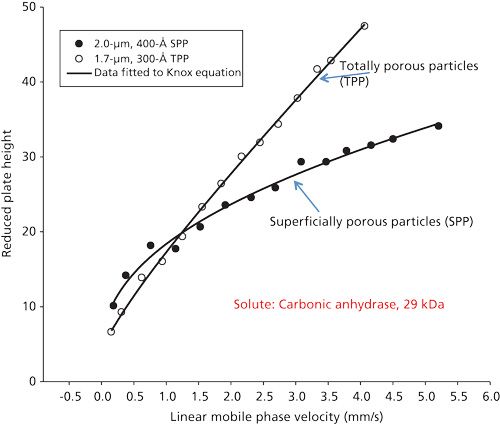
The most significant recent advancement in liquid chromatography (LC) column technology is the new generation of superficially porous silica particles.

Internal standard methods are used to improve the precision and accuracy of results where volume errors are difficult to predict and control.

One of the most frequent times that we discover a problem with a liquid chromatography (LC) method is when we examine a data set following the analysis of a batch of samples.

There has been a revival of supercritical fluid chromatography (SFC) in recent years, especially in the chiral preparative field, but also more recently in the analytical area. However, SFC is considerably more complex than liquid chromatography (LC), mainly because of the compressibility of the mobile phase. One can say that SFC is a "rubber variant" of LC where everything considered constant in LC varies in SFC. In this review, we go through advances in theory, instrumentation, and novel applications.

Limonin was separated from other components in citrus juice sample matrices by reversed-phase chromatography with ultraviolet detection.

There is a bewildering array of stationary-phase choices available for reversed-phase high performance liquid chromatography (HPLC), and even within each phase designation (such as "C18") the selectivity of each phase can vary widely.

Despite the utility of high performance liquid chromatography (HPLC) simulators, we found that all the free and low-cost simulators were outdated or had extremely limited functionality, so we created one that addressed these shortcomings. We developed a sophisticated, open-source HPLC simulator that is available for free as well as a version for Android users called "HPLC Simulator." Here we discuss a few questions that the simulator can help answer: Why are peaks narrower in gradient elution? What is gradient delay and how does it affect a separation?

Marijuana, the common or slang term for cannabis in its herbal form, is one of the most widely used illicit drugs in the world.

Why are liquid chromatography retention times sometimes so slow to stabilize?

Understanding the interactions that stationary-phase chemistries provide will help you choose the most appropriate blend of interactions to address a given separation challenge.

Methotrexate and sulfasalazine are often used together to treat rheumatoid arthritis, so it is valuable to be able to monitor plasma levels of both drugs simultaneously. This method achieves that by using two detector wavelengths, 304 nm for methotrexate and 358 nm for sulfasalazine.

Have a problem with your LC system? Maybe applying a little "DDT (Don't Do That)" may help.

Applications of miniaturized separation techniques for the analysis of illicit drugs and new psychoactive

This review will provide a brief introduction to active flow technology (AFT) with a particular focus on improvements in separation performance that can be achieved when using these columns and coupling with liquid chromatography–mass spectrometry (LC–MS).

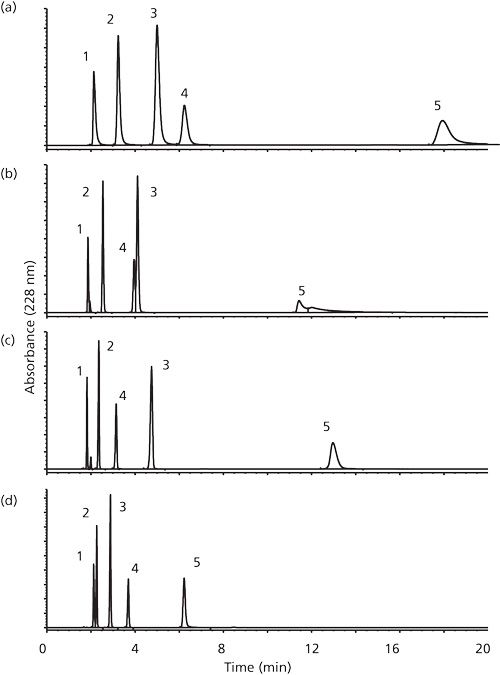
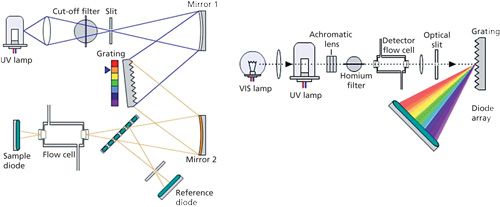
The ideal UV detector would allow us to monitor the presence of our target analytes without influence from the background eluent and sample matrix components that may be present in the detector measuring cell at the same time

Environmental sample analysis by large-volume injection (LVI) in combination with liquid chromatography–tandem mass spectrometry (LC–MS-MS) is described for polar and nonpolar analytes in both aqueous samples and organic extracts.

Make your column last forever? Not quite, but you can help prevent its early demise.

This review illustrates the benefits of LC?C in food analysis and discusses the combination of LC modes used in the two dimensions, and the nature of the samples analyzed.

A simple and rapid method for the simultaneous separation and determination of the inorganic ionic forms of As(III), As(V), Sb(III), Sb(V), Tl(I), and Tl(III) in river water samples is described.

Supercritical (subcritical) fluid chromatography (SFC) was evaluated as an alternative to HPLC for the enantiomeric separation of primary amines on a cyclofructan-based chiral stationary phase.

A discussion of the role of the gradient in separation by reversed-phase and ion-exchange HPLC, with data from two products to illustrate the key points

Understanding the chemistry of embedded polar group and perfluorophenyl phases leads to better decisions during method developement

How can resolution be determined when peak width cannot be measured?

Mechanical strength, acid and alkaline durability, loadability, and overload characteristics are a few of the parameters evaluated.