




LCGC Europe
Developments in the preparation of organic polymer monoliths suitable for the separation of small molecules in the isocratic mode are described and the main factors affecting column efficiency are identified.
LCGC Europe
Developments in the preparation of organic polymer monoliths suitable for the separation of small molecules in the isocratic mode are described and the main factors affecting column efficiency are identified.

LCGC North America
An updated overview of the development of SPP technology, including benefits, limitations, and the theory behind its success

LCGC North America
An interview with Jack Kirkland on his pioneering career in HPLC

LCGC North America
A look at two reader-submitted questions regarding method calibration
The Column
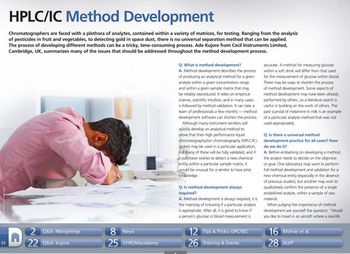
Chromatographers are faced with a plethora of analytes, contained within a variety of matrices, for testing. The process of developing different methods can be a tricky, time-consuming process. Ade Kujore from Cecil Instruments Limited, Cambridge, UK, summarizes many of the issues that should be addressed throughout the method development process.
LCGC North America
Some attributes of large molecules make them behave differently from small molecules in reversed-phase separations.
LCGC North America
Noteworthy new HPLC systems and related products

The Column
This article reviews key developments and potential advantages of using LC–MS for forensic toxicology, including the option of using oral fluid samples.

The Column
Mike Callahan, an analytical chemist at NASA's Goddard Space Flight Center (Maryland, USA), led a team to develop a new nano LC–nano ESI–MS method to detect life's building blocks in "spacedust". Callahan spoke to The Column about the inspiration behind the project, the challenges of analyzing extraterrestrial material in the laboratory, and future directions.

The Column
This article details how a newly developed ?dilute-and-shoot? sample preparation methodology for LC–MS–MS multi-residue monitoring (MRM) pesticide screening can enable operators to overcome the matrix effects that have traditionally hindered routine food analysis.

This article, transcribed from an LCGC web seminar presented on January 29, 2013, by Davy Guillarme of the University of Geneva and the University of Lyon, explains how HILIC works and provides keys to using the technique effectively.

The Column
Scientists in Malaysia have developed a useful metabolomics approach that could aid analysts working in natural drug discovery. The team applied liquid chromatography–mass spectrometry (LC–MS) coupled with principle component analysis (PCA) to screen more than 4000 natural extracts for novel photosensitizer drugs.
The Column
LC–MS Deconstructs the "Poppy Seed Defense"

LCGC Europe
This article focuses on the progression that chiral stationary phases (CSPs), specifically developed for HPLC, are currently undergoing because of the pressing need of an easy switch to UHPLC.

Michal Holcapek discusses what you need to consider when switching to a high resolution LC–MS system. Holcapek also offers advice on how to choose the most effective ionization technique for your analysis.

The Column
For proper column installation it is important to be familiar with column characteristics such as solvent compatibility, maximum flow rate, and maximum operating temperature.

The Column
To ensure an efficient, reliable, and sensitive determination of all corkiness-related off-flavour compounds in wine samples, the DLR Mosel in Germany has successfully turned to GC–MS combined with stir-bar sorptive extraction.

The Column
This article provides examples of the robustness of monolithic HPLC columns and how they can be used to help overcome the inherent challenges presented when analytes are in complex matrices.
LCGC Europe
Secondary parameters in the interface and mass analyzer can often have a major impact on sensitivity and reproducibility. This column considers how and when to consider optimizing these parameters through a study of the working principles of LC–MS analysis.
The Column
Oxycodone and its metabolites were analyzed by high performance liquid chromatography–mass spectrometry (HPLC–MS) using a diisobutyl stable bond column. This article discusses the results.

The Column
A fully automated solution was developed for the determination of THC and its metabolites THC–OH and THC-COOH in serum.
The Column
Potentially dangerous levels of the methamphetamine analogue, N, ??diethyl?phenylethylamine (N, ? -DEPEA), have been detected in a widely available dietary supplement using ultrahigh-pressure liquid chromatography coupled to mass spectrometry (UHPLC–MS). The supplement, Craze, can be bought in the USA and from on-line retailers. The findings have been published in the journal Drug Testing and Analysis by a team of scientists from Harvard Medical School (Massachusetts, USA), NSF International (Missouri, USA), and the National Institute for Public Health and the Environment Health Protection Center (Bilthoven, The Netherlands).1
LCGC North America
There are many ways to improve retention and selectivity in reversed-phase HPLC separations. Choosing the correct mobile phase is maybe the most important step.

LCGC North America
A number of popular myths or half-truths in UHPLC are described and data are provided that contradict some of these commonly held beliefs.

The Column
This article reviews some of the main developments that have led to recent advances in liquid chromatography–mass spectrometry (LC–MS).