





The Column
Whether organic produce provides any actual health benefits is still controversial, and a recent study of organic carrots, onions and potatoes has claimed that the process may add nothing at all.
The Column
Whether organic produce provides any actual health benefits is still controversial, and a recent study of organic carrots, onions and potatoes has claimed that the process may add nothing at all.

The Column
KNAUER has donated a high-quality analyser to the Hamburg University of Technology (TUHH) for use in education and training in the chemical engineering department.
Agilent Technologies has announced the opening of a new life sciences instrument manufacturing facility in Singapore. The facility will produce the company's LC-MS instruments for the global market.

The Column
The advantages of HPLC-Chip-MS workflow over conventional methods of N-glycan analysis

LCGC Asia Pacific
Direct-Electron Ionization is a useful tool in LC–MS. This article discusses the potential of this technique as a universal detector for small molecule analysis and how to deal with matrix effects.

LCGC Asia Pacific
If something doesn't look right you need to investigate!
LCGC Asia Pacific
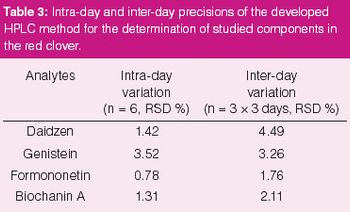
A simple and rapid HPLC method was established to simultaneously determine the active ingredients of red clover.

LCGC North America
John Dolan presents some practical pointers to get the most out of your UHPLC system.

LCGC North America
This article highlights a number of recent developments in HPLC for polyphenol analysis.

LCGC North America
The guest authors describe an optimization procedure to achieve the highest plate count in a given analysis time.

The Column
Accurate and sensitive all-ions quantification using ultra-high resolution LC-MS

The Column
Ultra high performance liquid chromatography (UHPLC) systems, also referred to as fast LCs, are designed to take full advantage of smaller particles (sub 2 ?m), which yield higher resolution and increased sensitivity.

The Column
Speaking to Konik-Tech about the development of a new system combining LC and GC technology.

The Column
Using SRM and H-SRM on an Integrated UHPLC-MS Platform for Sensitive, Accurate and Reproducible Quantification of Perfluorinated Compounds in Human Breast Milk.

LCGC Europe
Practical HPLC, HILIC and RP-LC methods of analysing common food and beverages containing polyphenols are presented.
LCGC North America
John Dolan discusses an inquiry he received from a reader complaining about the difficulty he was having meeting system suitability for an LC method that had been transferred into his lab.
LCGC North America
The principles and attributes of today's HPLC detectors are discussed, and the advantages and disadvantages of the various detectors are compared and contrasted.
The Column
Incognito provides a retrospective account on subjects visited throughout the course of the year and asks if any problems have been addressed and what new problems have arisen.

The Column
A study published in the Journal of Separation Science has looked at using the racemization of amino acids as a proxy for DNA preservation, giving archaeologists a rapid screening method for samples too badly damaged to extract.

LCGC Europe
A simple rapid HPLC method for simultaneously determiing formononetin, biochanin A, daidzen and genistein in Red Clover
LCGC North America
Guest author Stefan Brand and John Dolan take a look at how to speed up gradient separations while avoiding common errors.
LCGC North America
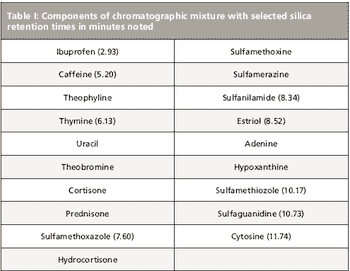
The authors compare five bonded phases with bare silica for the SFC separation of a 19-component mixture of polar analytes.
LCGC North America
Ron Majors presents his yearly review of the HPLC Conference.

LCGC Asia Pacific
An overview of current chromatography-based food toxicant screening is presented.

LCGC North America
The authors describe a study of screening procedures that demonstrated a relatively small set of columns can be used routinely.