

LCGC North America
Part IV of this series focuses on three different calibration models: external standardization, internal standardization, and the method of standard additions.

LCGC North America
Part IV of this series focuses on three different calibration models: external standardization, internal standardization, and the method of standard additions.

LCGC Europe
This article will discusss novel analytical methods for the discovery and trace analysis of biochemically active compunds in three main areas: protein analysis, screening technologies and multidimensional separations. The research in protein analysis describes analytical methods that involve automation and integration of sample clean-up, followed by separation and detection of the peptides/proteins.

LCGC Europe
The first in a series of interviews where rising research stars interview important figures from the world of chromatography kicks off with Gert Desmet from the Free University of Brussels talking to John Knox.

A study led by cancer researchers at Ohio State University's Comprehensive Cancer Center's Experimental Therapeutics Program.has validated a method for reliably measuring variations in certain proteins that may make good biomarkers in chronic leukemia patients.
Researchers from the Research Institute for Chromatography (Kortrijk, Belgium) and AstraZeneca R&D Charnwood (Loughborough, UK) used in-situ derivatization and liquid chromatography?mass spectrometry (LC?MS) to analyze arylamines and aminopyridines, which can be present as potentially genotoxic impurities in pharmaceutical preparations at trace levels.
The Chemical Heritage Foundation announced that David and Alice Schwartz, founders of Bio-Rad Laboratories (Hercules, California) will receive the organization?s fourth annual Richard J. Bolte Sr. Award for Supporting Industries.
The U.S. Drug Enforcement Administration (DEA) has bought a liquid chromatograph from Waters Corporation (Milford, Massachusetts) to use in forensic chemist training at Virginia?s Special Testing and Research Laboratory.
Agilent Technologies (Santa Clara, California) announced its support of prostate cancer research by the University of Michigan?s (Ann Arbor) Center for Translational Pathology through a grant of instruments and funding.

LCGC North America
Several approaches for purifying difficult samples more efficiently for discovery research support are mentioned in this paper. These approaches use mass triggered HPLC on various specialty columns.

LCGC North America
In part two of this series, John Dolan looks at the signal-to-noise ratio and its relationship to uncertainty in a measurement.
Special Issues
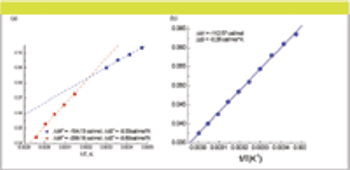
A fast enantiomeric separation of a chiral aromatic amine was achieved, using ultra high pressure liquid chromatography and highly sulfated β-cyclodextrin (S-β-CD) as a chiral additive in the mobile phase. The stationary phase consisted of a core shell support with a particle size of 2.7 µm. Under these conditions the baseline separation was obtained within 2.5 min. The influence of the concentration of the additive, along with the thermodynamics of the separation, were studied. Molecular mechanics calculations were consistent with the experimental data for the order of elution, providing further evidence of these interactions. The enantiomeric separation at high temperature (90 °C) using only water as mobile phase also was achieved for the first time.

Special Issues
Due to economic crisis all over the world it is a time of cost-friendly analyses. Superficially porous and monolithic columns are the tools to serve this purpose. These columns are new generation and can be used for ultrafast separations. This article describes the state-of-the-art for these stationary phases for high performance liquid chromatography (HPLC). The emphasis has been placed on their preparation, properties, applications, comparison, and future perspectives. It has been observed that superficially porous columns may be the choice of future for ultrafast separations.
Special Issues
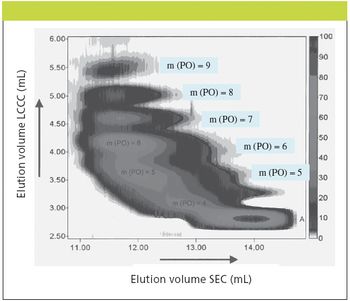
The use and evolution of the two-dimensional liquid chromatography (LCxLC) technique is explored with respect to instrumentation and applications.

Special Issues
During the last four to five years, chromatographers have witnessed some significant advances in technology, from the instrument perspective, with systems operating up to 15,000 psi using new and significantly improved detectors, sometimes operating in multiple dimensions, and from the column perspective, with smaller particle sizes and new chemistries and configurations.
Phenomenex Inc. (Torrance, California) raised raised $5,150 for Cheer for Children, a Redondo Beach based non-profit that raises donations to help acutely ill children and their siblings at County-Harbor UCLA Medical Center and for children with orthopedic disabilities at local schools, through a combination of sporting challenges, raffles, and refreshment sales.
Special Issues
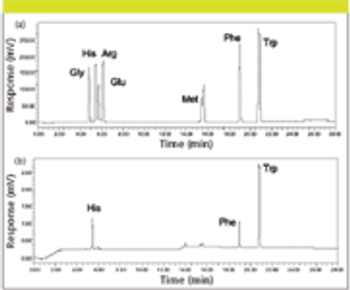
Over the past several years, charged aerosol detection (CAD) has become a widely used technology in the pharmaceutical laboratory. From formulation to stability and even quality control, many analysts are turning to this technology due to its advantages of sensitivity, ease of use, dynamic range, and applicability to a wide range of analyses in the drug development process. In this article, we will examine the operation and use of CAD in a regulated environment, briefly address method development and validation specifics, and highlight a few examples illustrating some of its advantages when used in the pharmaceutical laboratory.

LCGC Europe
An overview of contemporary techniques in environmental analysis.
Kalorama Information, leading healthcare market research publisher, announced that Liquid chromatography will see significant growth from a new application - food safety testing - after several highly publicized food scandals.
LCGC Europe
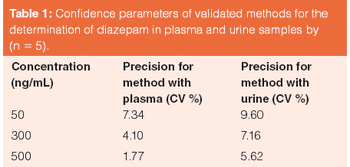
A rapid and simple high performance liquid chromatography (HPLC) method with basic extraction assays was developed to investigate free diazepam levels in the plasma and urine samples of patients medicated with this drug for the management of alcohol withdrawal syndrome. The HPLC analysis was optimized and evaluated for linearity, imprecision, recovery, detection and quantification limits. The method showed linearity between 50–500 ng/mL (r2 ≥ 0.990). Coefficients of variations (%CV) were calculated to be in the range of 1.77–9.60. According to ICH guidelines, theoretical limits of detection (LOD) and quantification (LOQ) for plasma and urine were calculated as 8.3 ng/mL, 27.5 ng/mL and 8.2 ng/mL, 26 ng/mL respectively. Diazepam monitoring in plasma and urine displayed remarkable variations. The importance of adjusting doses according to individual requirements and the routine monitoring of plasma or urine for patients under medication is highlighted.
Special Issues
The primary goal of early phase development is to gain a fundamental knowledge of the chemistry of drug substances and drug products to facilitate optimization of synthetic schemes and drug product formulations. At the same time, methods are required for release and stability studies to support clinical trials. Ultimately, the knowledge gained during early development translates into designing control methods for commercial supplies. Our approach to meeting this challenge is based upon the use of a primary method along with orthogonal methods. This paper will discuss the overall strategy, with an emphasis on the chromatographic conditions selected to provide systematic othogonality for a broad range of drugs. Case studies will be presented to demonstrate the utility of orthogonal methods to resolve issues that could not have been addressed using a single release and stability method.
The National Cancer Institute's Center for Cancer Research (Bethesda, Maryland), purchased a Waters ACQUITY UPLC®/Synapt High Definition MS (HDMSTM) and Waters ACQUITY® UPLC/XevoTM TQ MS Systems for its metabolomics research programs.
Agilent Technologies (Santa Clara, California) and Aurora SFC Systems (Sunnyvale, California) announced that Agilent is providing technical support for the development of Aurora?s SFC Fusion A5, a new instrument that converts existing high performance liquid chromatography (HPLC) systems into supercritical fluid chromatography (SFC) systems.
Reseachers from China Pharmaceutical University (Nanjing, China) used high performance liquid chromatography (HPLC) with photodiode-array detection and electrospray ionization mass spectrometry to analyze 12 flavonoids in Ginkgo biloba leaves.
After a brief illness, noted chromatographer Clarence S. "Bucky" Wentzel passed away Friday, February 20, 2009, at the age of 66.
LCGC (Chromatographyonline.com) has developed a pilot program with EARL (EARL2learn.com), the most extensive online library of interactive web-based learning material for analytical chemistry.