
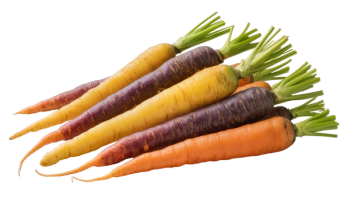
Color imaging and high-performance liquid chromatography (HPLC) reliably predicted pigment levels in carrots.
Color imaging and high-performance liquid chromatography (HPLC) reliably predicted pigment levels in carrots.

Hydrophilic interaction chromatography-mass spectrometry (HILIC-MS) profiling tied a senescence gene region to chlorophyll loss and seed protein in sunflowers.
Antonio Ferracane discusses moving to minimal sample preparation for PAH analysis, and why matrix-matched calibration can replace cleanup steps.

Gas chromatography-mass spectrometry (GC-MS) revealed exercise-driven metabolic reprogramming supporting neurogenesis.

For scientists who depend on accurate, traceable data every day, the tools they use matter enormously. Sartorius, a global leader in biopharma research and manufacturing solutions, has introduced its latest generation of laboratory balance—the Cubis III—and it reflects how much the expectations placed on such instruments have changed in recent years.

Gas chromatography with flame ionization detection (GC-FID) showed fermented cassava peel added to chicken feed optimized yolk fatty acid profile in eggs produced.
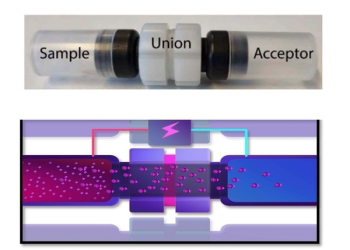
Electromembrane extraction (EME) uses electric fields and liquid membranes for selective, green microextraction compatible with chromatography.
Antonio Ferracane outlines a combined technique using cryogenic peak compression and pseudo-MRM to sharply boost sensitivity for trace PAHs.
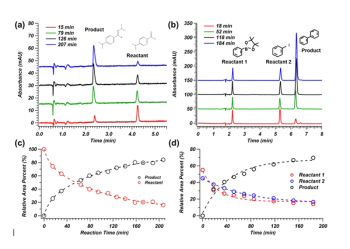
Recent developments in column technology and instrumentation for use in capillary-scale liquid chromatography are discussed. Key motivating factors for the increase in capillary liquid chromatography (LC) usage include a desire for more sustainable analytical methods (including reductions in solvent usage and waste generation) and the need for compact, field-portable systems that can be used in point-of-need settings. To achieve these goals, miniaturization strategies for both column and instrument designs have been required. The impact of these innovations in a variety of application areas—including environmental analysis, forensic testing, and pharmaceutical and biopharmaceutical manufacturing—is described. As the need for greener analytical methods continues to grow, the implementation of low-flow capillary-scale separations will also increase.

Isotope dilution liquid chromatography-tandem mass spectrometry (ID-LC-MS/MS) linked higher sleep apnea risk to lower testosterone and sex hormone-binding globulin (SHBG) levels.
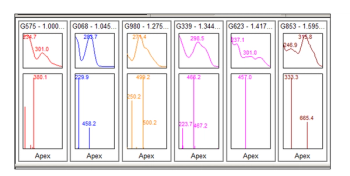
HPLC pharmaceutical analysis sometimes requires wavelengths beyond a drug's maximum UV absorption for optimal detection.

Researchers recently developed fluorinated solid phase microextraction (SPME) materials that improve the selective extraction and chromatographic detection of volatile per- and polyfluoroalkyl substances (PFAS) from complex samples. LCGC International spoke to the authors of the paper resulting from this work.
"Peak to Plate: Expert Insights in Food Analysis" brings you exclusive insights from chromatography professionals on the front line of food analysis.
In "Peak to Plate: Expert Insights in Food Analysis,” we present a compilation of the latest news articles and peer-reviewed content that highlight the utility of chromatography in food analysis. Happy reading!
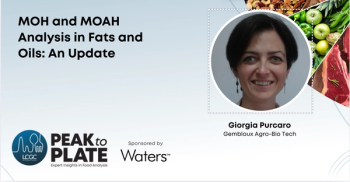
Giorgia Purcaro from the University of Liege (Belgium) discusses a laboratory technique for more accurately detecting harmful oil contaminants in edible oils than the current official method.
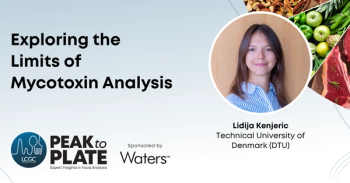
During her PhD at BOKU University Vienna, Lidija Kenjerić developed a multi-class UHPLC–MS/MS quantitative method covering 931 mycotoxins and secondary metabolites within an 11-min runtime, providing a scalable solution for routine testing, regulatory, and emergency response.

Gas chromatography-mass spectrometry (GC–MS) and liquid chromatography-mass spectrometry (LC–MS) identify volatile and nonvolatile flavor drivers shaping lager liking among high-flavor-preference consumers.
Stefan Van Leuwen and Jana Pulkrabova—co-chairs of RAFA 2026—elaborate on why separation scientists involved in food analysis should attend RAFA 2026, which takes place at the Clarion Congress Hotel Prague, Prague, Czech Republic, from November 3–6, 2026.
MOH contaminants in food pose safety risks, making reliable chromatographic detection essential.
LCGC International spoke to Maria Halabalaki, an associate professor at the National and Kapodistrian University of Athens, about how dried spot microsampling could transform food testing.

Ana Rodríguez-Bernaldo de Quirós of the University of Santiago de Compostela discusses how non-targeted gas chromatography–mass spectrometry (GC–MS) can reveal complex chemical mixtures in bioplastic food packaging, raising important safety questions and concerns for consumers.
Chromatographic mega-methods screen multiple mycotoxins, advancing food exposomics and public safety.

Liquid chromatography-coupled tandem mass spectrometry (LC-MS/MS) and high-resolution mass spectrometry (HRMS) reveal how glycoalkaloids transform in fried potato products.
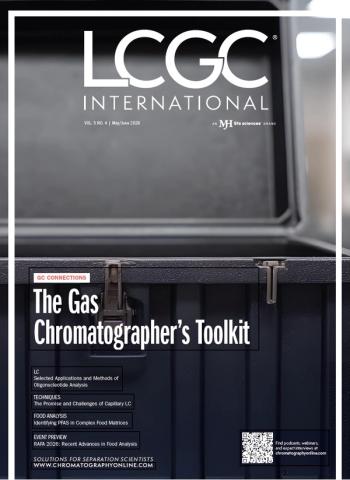
Click here to access the LCGC International May/June 2026 European PDF in an interactive format.

This week’s Chromatography Online website covered HTC-19 highlights, GC maintenance tips, CapLC challenges, and oligonucleotide troubleshooting.

Gas chromatography-mass spectrometry (GC-MS) and high-resolution metabolomics (HRMs) reveal how ergot alkaloids disrupt steer metabolism.
Click here to access the LCGC International May/June 2026 North American PDF in an interactive format.
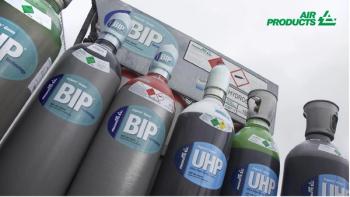
Ultra-high purity helium for gas chromatography.

Liquid chromatography-high resolution mass spectrometry (LC-HRMS) metabolomics reveals wastewater and stormwater impacts on mussel health.
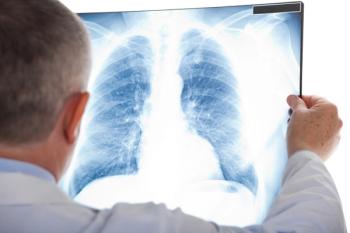
Targeted liquid chromatography-mass spectrometry (LC-MS) metabolomics identifies plasma biomarkers for lung cancer screening.