

All News
Advertisement

How fully can we characterize a biopharmaceutical? Strategies for demonstrating similarity, including statistical approaches. What the first US approval of a biosimilar tells us about the FDA's thinking.
Advertisement

The Application Notebook
Generally speaking, chromate - Cr(VI) - is classified as allergenic, carcinogenic, and extremely toxic and is subject to strict monitoring. Cr(VI) can occur in various concentrations in different areas, for example, drinking water, toys, or textile and leather products. Metrohm has developed ion chromatographic determination methods for determining Cr(VI) in various concentration ranges (ng/L to mg/L) with inline sample preparation techniques for various matrices. The method can be almost entirely automated. In the following application note, we present the analysis of hexavalent chromium in toys, leather, and drinking water.
Determination of Pesticide Residues in Blueberries by AOAC QuEChERS Approach and Dispersive SPE Cleanup with a Novel Sorbent ChloroFiltr®
ByUCT, LLC
The Application Notebook
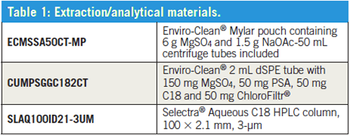
This application outlines a simple, fast, and cost-effective method for the determination of 34 multi-class pesticides, including one of the most problematic pesticides, pymetrozine in blueberries.
Quick and Convenient Comparison of Curry Powders Using Direct Thermal Desorption with GC-MS Analysis
The Application Notebook
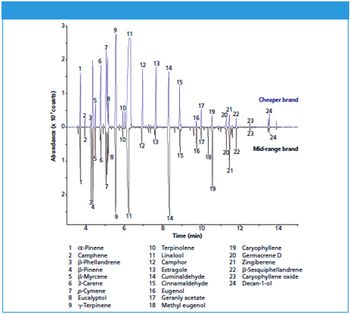
Herbs and spices are used in many food preparations, and identifying the differences between samples is of particular interest to manufacturers, both for ongoing quality control and to compare their products against competitors. However, the volatile organic compound (VOC) profiles of such samples often differ in the relative abundance of key components, and these differences can be difficult to assess by traditional methods such as solvent extraction, equilibrium headspace, or solid-phase microextraction (SPME).

The Application Notebook
Although pesticides protect crops and plants, they are known to be harmful and of toxicological significance. In order to ensure the safety of the food chain and to protect consumers, fast and reliable methods for the qualification and quantification of residual chemicals, contaminants, and pesticides in food and feed are essential. This article describes the method development and optimization of a fast and simple high performance liquid chromatography-mass spectrometry (HPLC-MS) assay for the separation, qualification, and quantification of common pesticides.
Advertisement

LCGC North America
A tribute to Roy Eksteen, who was a great man and a great proponent of the chromatographic sciences.
LCGC Europe
Click the title above to open the LCGC Europe December 2015 regular issue, Vol 28, No 12, in an interactive PDF format.
LCGC North America
Click the title above to open the LCGC North America December 2015 regular issue, Vol 33 No 12, in an interactive PDF format.

LCGC Europe
Paul R. Loconto shares his insights into the principles and practice of implementing and improving upon the original method to quantitate cyanide at trace concentration levels in human blood matrices using automated cryogenic trapping isotope dilution static headspace gas chromatography–mass spectrometry (GC–MS).
Advertisement

LCGC Europe
An excerpt from LCGC’s e-learning tutorial on UV detection for HPLC at CHROMacademy.com
Sponsored Content
Following on our previous Dedicated Dialogue which discussed lab water contaminants and purification technologies, this Dedicated Dialogue will consider specific ways to handle and manage a lab water purification system and the product water from these systems in order to ensure consistent and reliable results.

LCGC Europe
Characterization of macromolecules and colloids is an area of considerable interest. Asymmetrical flow field-flow fractionation (AF4) has become a well-established method, but many potential users possess limited knowledge of its capabilities, or how it can provide additional information or serve as validation to the traditional analytical techniques. This review article highlights several practical applications where AF4 should be given special consideration, and discusses benefits and drawbacks of the different methods.
The Application Notebook
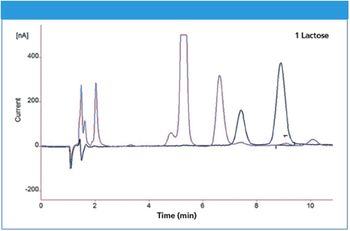
The market for lactose-free products is growing rapidly and constantly and Europe is a worldwide leader in the lactose‑free market. Between 2012 and 2016 the sales of lactose-free products are expected to increase by 75%.

LCGC Europe
How to get started in the process of identifying the problem source for column-related problems.

Sponsored Content
Following on our previous Dedicated Dialogue which discussed lab water contaminants and purification technologies, this Dedicated Dialogue will consider specific ways to handle and manage a lab water purification system and the product water from these systems in order to ensure consistent and reliable results.

The Column
Researchers at Zhejiang University, China, have developed a new method combining liquid chromatography-mass spectrometry (LC-MS) and off-line nuclear magnetic resonance (NMR) to analyze the constituents within traditional Chinese medicines (TCMs).

The Column
A new screening procedure has been developed for the detection of common “non banned” drugs used by athletes. The method targets multiple pharmacologically active compounds by liquid chromatography-electrospray ionization coupled to tandem mass spectrometry (LC-ESI-MS-MS).
The Column
Click the title above to open The Column November 23, 2015 Europe & Asia issue, Volume 11, Number 21, in an interactive PDF format.
The Column
Click the title above to open The Column November 23, 2015 North American issue, Volume 11, Number 21, in an interactive PDF format.

The LCGC Blog: Simple Visual Methods to Assess HPLC Column Performance — and Get You Out of Trouble!
The Column
LCGC Blogger Tony Taylor offers some simple visual methods to assess column performance.

They say a picture paints a thousand words… This month I’ve taken inspiration from a recent webcast, presented at www.chromacademy.com, in which I presented real data from our work that represents some ‘classic’ GC problems.
In this video, Robert T. Kennedy of the University of Michigan discusses the role of liquid chromatography–mass spectrometry (LC–MS) in the rapid development of metabolomics and the challenge of dealing with all the data. He then goes onto talk about the methods used in a recent study on glucose metabolism to analyse complex metabolic pathways and the challenges of using smaller samples.

Column overload is a very commonly encountered issue in GC for beginners. Changes in peak symmetry, generally observed as peak fronting, can be subtle in the sharp peaks generated by GC, but the result can be significant shifts in retention times, loss of resolution, and error in peak integration.

The Column
The characterization of paint in famous artworks is valuable for investigating the painting techniques used by artists, for conservation purposes and to help repair damaged paintings. By combining HPLC–ESI-QTOF-MS with traditional analytical techniques, researchers were able to clarify the composition of the oil components and hypothesize the botanical origin of the lipid materials used by Edvard Munch.

The Column
Kevin Schug discusses why we need a comprehensive study of unconventional oil and natural gas (UOG) extraction processes.

The Column
“A Toolbox for LC–MS Protein Analysis” from EMD Millipore will be held on 17 and 18 November 2015.
The Column
Click the title above to open The Column November 06, 2015 Europe & Asia issue, Volume 11, Number 20, in an interactive PDF format.
Advertisement
Advertisement
Trending on LCGC International
1
Where LC-MS/MS Meets the ER Clock: The Case for Paper Spray-MS in Acute Drug Toxicity Screening
2
LC-MS/MS Reveals Fentanyl Tolerance in Users
3
Detecting Anabolic-Androgenic Steroids in E-cigarettes Seized from Scottish Prisons using GC–MS
4
Automated Sample Preparation for Oligonucleotide Bioanalysis Using Magnetic SPE
5