
In this month's installment of "LC Troubleshooting," John Dolan takes a look at solvent strength and sees how we can use it to make predictable changes in the peak movement for reversed-phase LC separations.


In this month's installment of "LC Troubleshooting," John Dolan takes a look at solvent strength and sees how we can use it to make predictable changes in the peak movement for reversed-phase LC separations.

Guest authors Luke Chimuka and Ewa Cukrowska provide an in-depth look at the verious approaches to passive sampling, weighing the merits and challenges for each type.

Globally, 2005 sales of pharmaceuticals have been estimated at approximately $550 billion. A significant fraction of this amount was due to the top pharmaceutical companies in the world. The top five companies alone were responsible for total revenues of $168 billion, or 30% of the entire market.

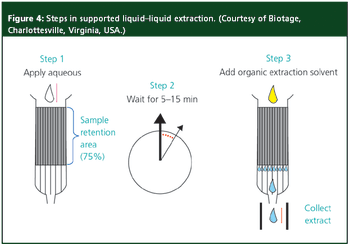
Liquid–liquid extraction (LLE) is among the most widely used sample preparation methods. In this month's instalment of "Sample Preparation Perspectives," Ron Majors discusses newer LLE approaches that offer significant advantages over classic methods. The miniaturization of LLE has resulted in solvent and time savings, improved automation possibilities and faster sample preparation. The techniques of single-drop microextraction, extraction in levitated droplets, flow injection-, membrane-based- and solid-supported extractions are reviewed. Often, these techniques use the same immiscible solvent pairs of conventional LLE.

This month's installment of "Column Watch" is the conclusion of a two part series in which Ron Majors examines the trends in columns and sample preparation at Pittcon 2006.

In part I of a two-part series, the author introduces several methods to reduce error in your chromatographic analyses.

This month's installment of "Column Watch" is the first of a two-part series in which Ron Majors examines the trends and highlights in columns and consumables at Pittcon 2006.

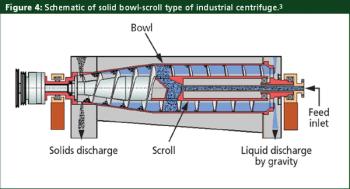
The two most popular mechanical techniques for sample preparation for large-scale protein production are concussion and liquid shear.

Protein unfolding and aggregation can be serious considerations when designing laboratory and preparative chromatographic purification steps. This problem has been studied most thoroughly within the contexts of reversed-phase chromatography and hydrophobic interaction chromatography. However, there are currently no robust methods for resin selection capable of predicting adsorbed-phase protein stability as a function of amino acid sequence, secondary or tertiary structure, or resin characteristics.

In this month's "LC Troubleshooting," we look at two questions submitted by readers that relate to mobile phase.

The authors review the latest technologies in MPT sample preparation used in study of genomics, proteomics, and metabolomics.

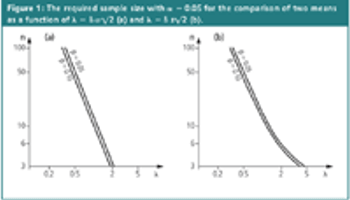
The sample size is determined by three factors: the size of the difference between the means that should be detected, the precision of the methods being compared and the significance levels at which the test is performed.

Guest columnist Matt Przybyciel reviews the structure, behavior, and applications of both alkyl- and phenyl-fluorinated phases in HPLC.

The authors provide the latest information on new stationary phases for modern TLC and high performance TLC (HPTLC), along with helpful hints on how to get the most out of this flexible form of chromatography.

This month's installment of "Column Watch" is the conclusion of a two-part series in which Ron Majors examines the trends in column introductions at Pittcon 2005. Here, he discusses gas chromatography columns, sample preparation products, hardware, and accessories.

This month's guest authors review the application of solid-phase microextraction (SPME) to the analysis of drugs in human plasma discussing important factors in the optimization of extraction efficiency. The column concludes with a discussion of method validation issues.

Pittcon 2005 - the 56th Pittsburgh Conference on Analytical Chemistry and Applied Spectroscopy - returned to the Orange County Convention Center, Orlando, Florida, 27 February-4 March 2005. This year's event hosted more than 900 instrument manufacturers and 1aboratory suppliers in more than 2300 booths. In addition to attending the exposition, the conferees were able to listen to numerous oral presentations, view more than 900 posters, check out 38 seminar rooms, or attend one of 150 short courses.

In this article, the authors look at ways to increase sample throughput for routine environmental analysis. Several strategies aimed at enhancing laboratory productivity are highlighted and illustrated with from-the-floor applications.

This month's column reviews some key considerations in the manufacture and use of microplates with particular reference to the 96-well plate.

Formic acid often is used for the analysis of peptides in proteomic studies by HPLC-MS, due to its volatility and reduced signal suppression. However, poorer chromatographic performance can be obtained in comparison with trifluoroacetic acid or nonvolatile phosphate buffers due to increased overloading, which can occur even for extremely small sample masses. Comparison of a highly inert silica-ODS and a wholly polymeric phase indicated that overloading effects on both are very similar and caused by the mutual repulsion of solute ions on the hydrophobic column surface.

Reagent water is used in all aspects of liquid chromatography (LC) technology, from preparation of mobile phase to preparation of standards, blanks, and samples. Reagent water is the most widely used analytical solvent, yet it is the least characterized, especially in total organic carbon (TOC) content. TOC adversely effects performance of LC methods and hence, reagent water quality is a major issue. Organics initially present in tap water will be reduced efficiently to low parts-per-billion concentrations by combining several technologies embedded in a water purification system. Monitoring the TOC concentrations gives chromatographers added confidence in their results.


The second part of a two-part series examining new column introductions at Pittcon 2004.

A novel device for coupling on-line in-tube SPME with capillary GC is presented by the guest authors and the method's application demonstrated for the analysis of contaminants in water.

This month'ss "Column Watch" is the first of a two-part series that examines new column introductions at Pittcon 2004.