

Sponsored Content - NA
Eliminating laborious sample preparation, field-flow fractionation greatly facilitates the absolute characterization of lignosulfonates by multi-angle light scattering.
Sponsored Content - NA
Eliminating laborious sample preparation, field-flow fractionation greatly facilitates the absolute characterization of lignosulfonates by multi-angle light scattering.
Sponsored Content
Plastics play a role in just about every market sector and research area including agriculture, food, packaging, pharmaceuticals, medical implants, and personal care products, making the potential leaching of additives like antioxidants or slip additives a major concern. In this article learn how the EDGE is able to extract additives from plastics in a fraction of the time of traditional techniques.
Sponsored Content - NA
Analytically, OPPs can pose some challenges due to the wide diversity of physical structures and behavioral characteristics of individual analytes. This often results in individual extraction protocols being implemented for labs to meet regulatory compliances. With the FMS, Inc TurboTrace® ABN Multi Cartridge SPE system, and its ability to incorporate dual cartridge extractions, it is possible to pair analytes with dissimilar characteristics into a single, fully automated extraction process.
Sponsored Content - EU
Analytically, OPPs can pose some challenges due to the wide diversity of physical structures and behavioral characteristics of individual analytes. This often results in individual extraction protocols being implemented for labs to meet regulatory compliances. With the FMS, Inc TurboTrace® ABN Multi Cartridge SPE system, and its ability to incorporate dual cartridge extractions, it is possible to pair analytes with dissimilar characteristics into a single, fully automated extraction process.
LCGC Europe
This application note describes the use of ISOLUTE SLE+ for extraction of estrone (E1) and estradiol (E2) from human serum. Analysis is performed by an HPLC-MS/MS method that gives limits of detection of 0.001 ng/mL without derivatization or fluoride adduct stabilization. ISOLUTE SLE+ products provides high analyte recoveries, no emulsion formation and significantly reduced sample preparation time compared to traditional liquid-liquid extraction.
LCGC Europe
11-nor-9-Carboxy-THC, also known as THCA or carboxy-THC, is the main secondary metabolite of THC (the active component of marijuana) formed in the human body [1]. THCA is excreted in urine in the form of glucuronide conjugates. THCA is not psychoactive but has a long half-life of up to several days or even weeks in very heavy users, thus determination of THCA in urine plays an important role in confirmation of marijuana consumption. The Substance Abuse and Mental Health Services Administration (SAMHSA) has set the THCA cutoff concentration of confirmatory testing at 15 ng/mL. Typical sample preparation methods for THCA in urine include liquid-liquid extraction (LLE) and solid phase extraction (SPE). This application utilizes a novel sample preparation technique, QuEChERS to effectively quantitate THCA levels in human urine.
LCGC Europe
Using a targeted solid phase extraction (SPE) method and GC–ECD analysis, chlorinated pesticides are extracted from poultry fat resulting in a method that decreases the amount of labor and reagents when compared to the USDA-FSIS CHC2 method.
LCGC Europe
A simple, automatable cleanup method is developed for the analysis of acrylamide from coffee, yielding absolute recoveries that exceed 92% when analyzed by LC–MS-MS.
LCGC North America
Using a targeted solid phase extraction (SPE) method and GC–ECD analysis, chlorinated pesticides are extracted from poultry fat resulting in a method that decreases the amount of labor and reagents when compared to the USDA-FSIS CHC2 method.
LCGC North America
A simple, automatable cleanup method is developed for the analysis of acrylamide from coffee, yielding absolute recoveries that exceed 92% when analyzed by LC–MS-MS.
LCGC North America
Cannabinoids are successfully extracted from a complex brownie matrix using the QuEChERS sample preparation technique, significantly reducing the presence of matrix interferences. The resulting clean samples are analyzed by GC–MS using a specialized deactivated GC column to provide heightened peaks for the cannabinoid compounds.
LCGC North America
EPA Method 625 is greatly simplified by using solid phase extraction (SPE) as an alternative to traditional liquid-liquid extraction (LLE). Using this SPE technique, paired with a sensitive GC–MS analysis, increases throughput and data quality, while decreasing manual labor and solvent usage.
LCGC Europe
Cannabinoids are successfully extracted from a complex brownie matrix using the QuEChERS sample preparation technique, significantly reducing the presence of matrix interferences. The resulting clean samples are analyzed by GC–MS using a specialized deactivated GC column to provide heightened peaks for the cannabinoid compounds.
LCGC Europe
Improving and optimizing EPA Method 593 using solid phase extraction (SPE) enhances sensitivity and maximizes efficiency while screening by LC–MS-MS for different female birth control hormones present in drinking and waste water.
LCGC Europe
EPA Method 625 is greatly simplified by using solid phase extraction (SPE) as an alternative to traditional liquid-liquid extraction (LLE). Using this SPE technique, paired with a sensitive GC–MS analysis, increases throughput and data quality, while decreasing manual labor and solvent usage.
LCGC North America
Phospholipid removal proves to yield superior results as compared to a traditional protein precipitation step when analyzing a complex plasma matrix via LC–MS-MS. The results displayed a decrease in ion suppression, increased analyte sensitivity, and an improvement in column lifetime.
LCGC Europe
Enhancing the extraction of vitamins A and E in serum using simplified liquid extraction (SLE) significantly improves the LC–MS-MS detection of target compounds, all while preserving a simple and robust method.
LCGC Europe
Phospholipid removal proves to yield superior results as compared to a traditional protein precipitation step when analyzing a complex plasma matrix via LC–MS-MS. The results displayed a decrease in ion suppression, increased analyte sensitivity, and an improvement in column lifetime.
LCGC North America
Enhancing the extraction of vitamins A and E in serum using simplified liquid extraction (SLE) significantly improves the LC–MS-MS detection of target compounds, all while preserving a simple and robust method.
LCGC North America
Using oral fluid as the matrix, a viable and simple solid phase extraction method for a wide range of drugs is developed. Several oral fluid collection devices were evaluated to determine the effectiveness of the cleanup procedure, ultimately confirming that the method is both robust and widely applicable.
LCGC North America
Improving and optimizing EPA Method 593 using solid phase extraction (SPE) enhances sensitivity and maximizes efficiency while screening by LC–MS-MS for different female birth control hormones present in drinking and waste water.
LCGC Europe
Using oral fluid as the matrix, a viable and simple solid phase extraction method for a wide range of drugs is developed. Several oral fluid collection devices were evaluated to determine the effectiveness of the cleanup procedure, ultimately confirming that the method is both robust and widely applicable.
LCGC Europe
An ultra-sensitive sample preparation technique using solid phase extraction (SPE) microelution 96-well plates effectively concentrates peptides and allows for cleanup of small volume.
LCGC North America
A suite of unknown drug compounds from whole blood are analyzed by LC–MS-MS, requiring the need for an effective yet nonspecific cleanup technique. The resulting method demonstrates a simple and fast sample preparation procedure that is suitable for screening many compounds.
LCGC Europe
A suite of unknown drug compounds from whole blood are analyzed by LC–MS-MS, requiring the need for an effective yet nonspecific cleanup technique. The resulting method demonstrates a simple and fast sample preparation procedure that is suitable for screening many compounds.
LCGC North America
An ultra-sensitive sample preparation technique using solid phase extraction (SPE) microelution 96-well plates effectively concentrates peptides and allows for cleanup of small volume.

The Application Notebook
SPME-GC–MS with on-column injection can be successfully employed for flavour profiling of food samples. The on-column injector of the GC-2010 can be used for SPME without any modifications, only an external ring adapter was used to facilitate the injection. The data can be compared with sensorial data of food.

The Application Notebook
Catecholamines are important markers for the diagnosis and management of tumour diseases of the sympathoadrenal system. The major catecholamines are dopamine, norepinephrine and epinephrine. Urine tests have shown to be applicable to measure the level of catecholamines in the human body. Various separation methods have been used for the clean-up of catecholamines in biological fluids: solvent extraction, adsorption on alumina, ion-exchange and solid-phase extraction of a diphenylboronic acid-catecholamine complex. From the point of simplicity, reproducibility and automation the last method is the most suitable and can be realized by on-line SPE–LC. Diphenylborate forms a negatively charged complex with the diol groups of catecholamines. These complexes which are strongly retained on a polystyrene-divinylbenzene cartridge in alkaline medium (pH 8.5) can be eluted in a second step from the SPE unit directly onto the HPLC column. The separation of catecholamines is performed in isocratic mode by..
The Application Notebook
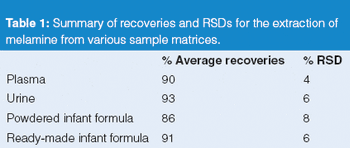
The use of EVOLUTE CX mixed-mode columns provides high and consistent recoveries across a range of complex matrices, from biological fluids to milk products. The dual retention mechanism ensures that matrix components such as proteins, salts and phospholipids are removed, resulting in lower ion suppression and accurate analysis.

The Application Notebook
The United States Food and Drug Administration (U.S. FDA) and the European Union (EU) have published regulations and provided guidance on the use of chemicals in food packaging materials. Tekmar provides method parameters for the HT3â„¢ Automated Headspace Analyzer for the determination of VOCs that may be contained in food contact packaging materials under various conditions. Temperature and mixing parameters were investigated to determine which VOCs may be released when subjected to these conditions.