Application Notes: Sample Prep

i1-601831-1408649261632.jpg

In U.S. EPA Method 5035 there are two collection options for samples containing high levels of volatile organic compounds (VOCs). The first involves collecting a bulk soil sample in the field. In the lab, the bulk soil is dispersed in a water miscible solvent. Next, an aliquot of the solution is added to 5 mL of water and finally, the sample is purged. The second option is to collect a 5 g soil sample and add it to a pre-weighed vial containing a prescribed amount of water miscible solvent. An aliquot is then purged. Both of these processes are time consuming and have the potential to introduce human error both in the field and in the laboratory.

i2-581403-1408660972772.gif

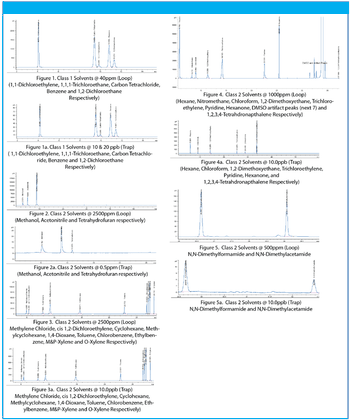
Residual solvents in pharmaceuticals are defined as volatile organic chemicals that are used or produced in the manufacture of drug substances, excipients or in the preparation of drug products. Because residual solvents do not provide therapeutic benefits, they should be removed, to the extent possible. Drug products should contain no higher levels of residual solvents than can be supported by safety data. Looking forward to the implementation of a revised USP <467> method, Teledyne Tekmar evaluated the new protocol, therefore this application will comply with the procedure and criteria changes set forth in the USP30 NF25, Second Supplement (effective December 1, 2007) and the interim revision announcement. (1)

i1-581406-1408660962773.jpg

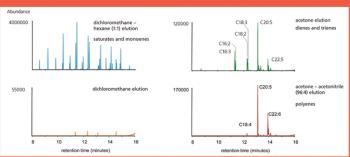
LC–GC approaches to analysis are particularly attractive because they combine the selectivity of solid phase sorbents in the first dimension with the separating power and peak capacity of a capillary GC column in the following dimensions. Their widespread use is limited because of the difficultly in desolvating the stream from the LC dimension without the solvent vapour passing down the GC column in significant quantity. An alternative approach to elution chromatography in the first dimension is to harness the specificity of the solid-phase process for digital chromatography using discontinuous changes in solvent polarity. Digital chromatography on a small sorbent bed reduces the volume of mobile phase to discrete plugs that are sufficiently small to be injected directly into a GC with a large volume injector or, alternatively, subsampled into a conventional split/splitless injector.

i1-581379-1408661072905.jpg

The Pirkle - Type Whelk-O®1 CSP is a synthetically made chiral selector covalently bonded to a silica support. This phase is well known in the industry for its broad degree of generality, mobile phase compatibility, and ability to invert elution order. Most commonly used polysaccharide coated CSP's are sensitive to the presence of certain mobile phase modifiers such as DEA, TEA, and TFA. Retained memory effects can adversely affect a separation resulting in broad and tailing peaks, no peak elution, and reduced or loss of separation altogether. To remove these unwanted memory effects, the column must be rinsed with an alcohol, such as methanol or ethanol. This is a time consuming and costly process. The Whelk-O®1 CSP does not exhibit any such retained memory behavior.

i2-581400-1408660982614.gif

Sample preparation is an essential technique to remove unwanted matrix components prior to LC–MS-MS analysis of drugs in biological fluids. Plasma matrix components whether endogenous (salts, proteins, and phospholipids) or exogenous (dosing vehicles, e.g. PEG 400), can interfere with compounds of interest leading to regions of ion suppression or enhancement. This can lead to inaccurate quantitation and have adverse effects on sensitivity. Mixed-mode SPE provides cleaner extracts as a result of rigorous interference wash steps, afforded by the dual retention mechanism of the sorbents.

i4-575598-1408667244956.gif

A new technique, QuEChERS, standing for Quick, Easy, Cheap, Effective, Rugged, and Safe, is readily accepted by both the AOAC International and the Committee of European Normalization (CEN) for the pesticide residues in foods and agriculture products. Waters DisQuEâ„¢ Dispersive Sample Preparation Kit contains conveniently-packaged centrifuge tubes with pre-weighed sorbents and buffers designed for use with the AOAC official QuEChERS methods.

i2-575594-1408667270648.gif

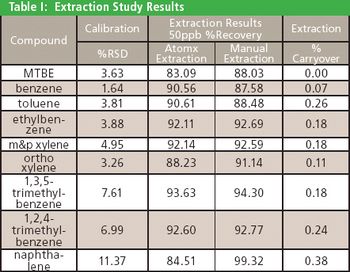
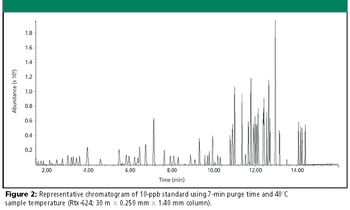
The purge-and-trap (P&T) technique for analysis of volatile organic compounds (VOCs) was pioneered in the 1970s at the United States Environmental Protection Agency (USEPA) research laboratory in Cincinnati. Many of the operational parameters developed during this time period are still included in USEPA methods. While these parameters still produce good analytical results, they do not take advantage of advances in instrumentation that enable analysis of emerging contaminants such as fuel oxygenates, and increased sample throughput.

i1-575609-1408667193558.jpg

Sample preparation is an essential technique to remove unwanted matrix components prior to LC–MS-MS analysis of drugs in biological fluids. Plasma matrix components whether endogenous (salts, proteins, and phospholipids) or exogenous (dosing vehicles, e.g. PEG 400), can interfere with compounds of interest leading to regions of ion suppression or enhancement. This can lead to inaccurate quantitation and have adverse effects on sensitivity. Mixed-mode SPE provides cleaner extracts as a result of rigorous interference wash steps, afforded by the dual retention mechanism of the sorbents.

i4-575627-1408667148261.jpg

Our work focuses on the synthesis of branched (functionalized) polydienes via a facile two-step synthesis. Despite the numerous strategies developed for the preparation of branched polymers in recent years, there is still a limited number of simple synthetic strategies based on common vinyl monomers.

i1_t-575595-1408667265796.gif

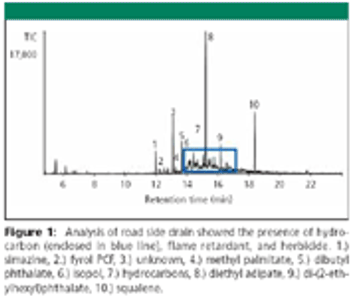
MEPS uses a barrel insert and needle (BIN) device to reduce Solid-Phase Extraction (SPE) to a micro-scale suitable for small volume samples and for the online adaptation of conventional SPE techniques. Because the SPE cartridge (BIN) is incorporated into the needle assembly of a gas-tight syringe, MEPS is also a simple field-portable SPE device that may be operated manually without need for sampling pumps or, alternatively, may be incorporated into robotic samplers. MEPS devices are of glass and stainless steel construction allowing them to be fully immersed for sampling at depth or, alternatively, used at needle depth to avoid perturbing the stream from which the sample was drawn. An extension pole allowed MEPS to be used to sample back along pipes or down inspection vents. When sampling from drainage pits and open sumps, there was minimal requirement to remove grates to gain access. An extension pole also allowed sampling from outflows that were offensive and could be readily adapted for safe sampling of..

i2-547867-1408670660128.gif

MEPS uses a barrel insert and needle (BIN) device to reduce Solid-Phase Extraction (SPE) to a micro-scale suitable for small volume samples and for the online adaptation of conventional SPE techniques. Because the SPE cartridge (BIN) is incorporated into the needle assembly of a gas-tight syringe, MEPS is also a simple field-portable SPE device that may be operated manually without need for sampling pumps or, alternatively, may be incorporated into robotic samplers. MEPS devices are of glass and stainless steel construction allowing them to be fully immersed for sampling at depth or, alternatively, used at needle depth to avoid perturbing the stream from which the sample was drawn. An extension pole allowed MEPS to be used to sample back along pipes or down inspection vents. When sampling from drainage pits and open sumps, there was minimal requirement to remove grates to gain access. An extension pole also allowed sampling from outflows that were offensive and could be readily adapted for safe sampling of..

i3-547862-1408670671561.gif

Dionex has developed a new standard for flow-through solvent extraction which allows accelerated solvent extraction (ASE®) of matrices that have undergone acid or alkaline pretreatment or digestion. The new ASE 150 and ASE 350 systems use extraction cells and post-cell solvent pathways constructed of Dionium™ material. This pH-hardened substance resists corrosion under acidic or alkaline conditions used in standard pretreatments, widening the scope of ASE applications and significantly expanding its capabilities.

i4-547966-1408670464057.jpg

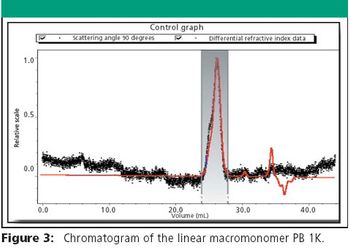
Size exclusion chromatography is a powerful tool for the characterization of molecules differing in size and molar mass. It is widely used and well known for the determination of molar mass distributions and molar mass averages. For membranes GPC-SEC is a useful characterization method as it can measure the membrane characteristic pore size distribution, average pore size and molecular cut-off significantly faster than other methods.

i1-547880-1408670608464.jpg

The United States Pharmacopeia (USP) has implemented a revised method for the determination of residual solvents, chapter 467; this revision has brought the methodology of USP 467 into close alignment with European Pharmacopeia (EP) method 2.4.24. The USP and EP determination of class 1 and class 2 residual solvents is performed with static headspace (HS) sample introduction and gas chromatography (GC) with flame ionization detection (FID); class 3 has flexibility in the technique, however, it is often included in the HS analysis.