Application Notes: LC


With the 1290 Infinity HDR DAD the determination of low and high dose drugs present in a fixed dose combination drug was possible in one run, due to the increased linear dynamic range by >30x.

The term ionic liquid refers to organic salts with relatively low melting points (below 100 °C) that usually consist of an organic cation or anion and a counterion, in either organic or inorganic form. Ionic liquids exhibit unique characteristics such as extremely low vapour pressure, excellent thermal stability, electrical conductivity, a high degree of polarity and miscibility with various types of solvents. Ionic liquids have been used as catalysts and solvents in organic chemistry and electrochemistry and as mobile phase modifiers or functionalized stationary phases in separation science.1–3

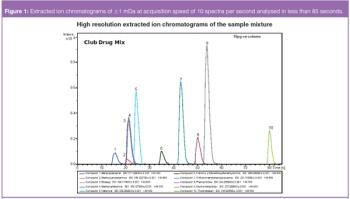
In the pharmaceutical industry the increased efficiency brought about by new fast chromatography methods needs to be matched by commensurate mass spec capabilities. maXis UHR-TOF is the instrument of choice to keep up with fastest chromatography.

Catecholamines are important markers for the diagnosis and management of tumour diseases of the sympathoadrenal system. The major catecholamines are dopamine, norepinephrine and epinephrine. Urine tests have shown to be applicable to measure the level of catecholamines in the human body. Various separation methods have been used for the clean-up of catecholamines in biological fluids: solvent extraction, adsorption on alumina, ion-exchange and solid-phase extraction of a diphenylboronic acid-catecholamine complex. From the point of simplicity, reproducibility and automation the last method is the most suitable and can be realized by on-line SPE–LC. Diphenylborate forms a negatively charged complex with the diol groups of catecholamines. These complexes which are strongly retained on a polystyrene-divinylbenzene cartridge in alkaline medium (pH 8.5) can be eluted in a second step from the SPE unit directly onto the HPLC column. The separation of catecholamines is performed in isocratic mode by..


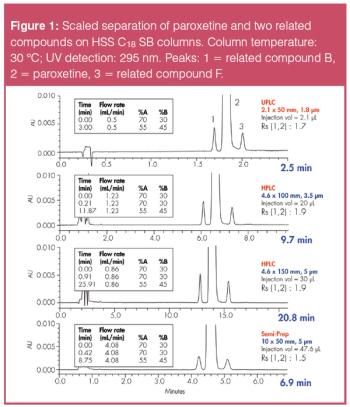
As UPLC users convert or replace their existing HPLC systems with UPLC systems there is a transition period where a method must be run on both platforms. Thus, having the same particle substrate and bonded phases available in HPLC and UPLC particle sizes can significantly ease the burden of method development and transfer from one platform to another. In addition to the ethylene bridged hybrid (BEH) particle, three new high strength silica (HSS) stationary phases for HPLC applications are introduced. Scalability between both column diameter and particle size is demonstrated on both UPLC and HPLC instrumentation.

Increase throughput of the HPLC method for triazine herbicides by employing ultra high-speed liquid chromatography at elevated temperature on a heat stable Thermo Scientific Hypercarb column.

All plant foods are complex mixtures of chemicals including both nutrients and biologically active non-nutrients, referred to as phytochemicals. Soy is known for having high concentrations of several physiologically-active phytochemicals, including isoflavones, phytate (inositol hexaphosphate), saponins, phytosterols and protease inhibitors. The isoflavones are what makes soy unique.

Flavanones are a type of flavonoids occurring widely in plants, either in the aglycone backbone form itself or as glycosides. Flavonones exist in unique forms depending on the type of fruit and can be used to indicate the type of fruit that is being analysed. The following application introduces examples of high-speed analysis of flavanones in citrus juice using the Shimadzu ultra fast LC system, prominence UFLC, and the photodiode array detector SPD-M20A, focusing on narirutin, naringin, neohesperidin and hesperitin.

The FDA has no objection to Rebaudioside A having a generally recognized as safe (GRAS) status as a sweetener for food and drink.1 Stevia sweeteners may contain other steviol glycosides as well, mainly Stevioside, Rebaudioside C and Dulcoside A. Because the FDA GRAS confirmation is only for the use of Rebaudioside A at 95% purity or above in food and beverages, stevia extracts must be highly purified and characterized prior to use.

Zhe Yin, Kenneth J. Fountain, Erin E. Chambers and Diane M. Diehl, Waters Corporation, Milford, Massachusetts, USA.

Based on the QuEChERS AOAC Official Method 2007.01, 16 pesticides were used for evaluating the performance of the Agilent's AOAC buffered extraction and SampliQ QuEChERS dispersive SPE kits for general fruits and vegetables.

Tobacco specific nitrosamines (TSNA) are a group of carcinogens found only in tobacco products and are formed from nicotine and related alkaloids during the production and processing of tobacco and tobacco products.

Polynuclear aromatic hydrocarbons (PAHs) are carcinogenic condensed ring aromatic compounds widely found as trace pollutants in waters, wastes, air particulates, soil and foods. PAHs can be routinely monitored using HPLC with a combination of UV and fluorescence detection as prescribed in EPA methods 550.1, 610 and 8310.

Polyaromatic hydrocarbons (PAH) are particularly relevant in the analysis of environmental pollution because of their ubiquity, toxicity and persistence. Consequently, the PAHs have become the most intensively studied pollutants in environmental analysis.

Salt formation is a critical aspect in drug development and HPLC is an important tool for determination of pharmaceutical counterions.

Since melamine and its metabolites are extremely polar compounds, they serve as very good candidates for HILIC chromatography. Simultaneous and fast determination and confirmation of melamine and cyanuric acid along with two other compounds using a novel amino bonded phase in HILIC mode coupled with a complete solutions approach is presented.

An Agilent ZORBAX Rapid Resolution HT Eclipse Plus Phenyl-Hexyl column resolved many compounds from Stevia rebaudiana Bertoni plant extracts using an isocratic reversed phase method with UV and MS detection instead of a typical approach employing an amino column with a refractive index or other special detector. The Eclipse Plus Phenyl-Hexyl method's advantages include high peak capacity, isocratic mobile phase, low acetonitrile consumption, and MS compatibility.

Simulated Moving Bed technology (SMB) is a continuous chromatography technique widely used in the pharmaceutical/biotechnology industry. The continuous chromatographic separation of sodium sulphate (Na2 SO4) from a mixture of glucose and mannose was established by using the Orochem Zuccheroâ„¢ columns and the SMB technology. The main advantages of SMB over batch chromatography includes better yields, higher purity, and decreased solvent usage, which together make the SMB technology economically viable and ideal for desalting applications.

Many polar compounds are difficult to retain by reversed-phase analysis without the use of ion-pair chromatography. We have overcome this disadvantage with a revolutionary phase structure called "Multi-mode ODS." This technology uses uniformly blended packing material consisting of two types of porous silica particles: 3 μm silica substituted with ODS+cation ligands and 3 μm silica substituted with ODS+anion ligands (Figure 1). This novel multi-mode ODS column, named Scherzo SM-C18, enables a multi-separation mode, consisting of: anion exchange, cation exchange, normal phase, and reversed-phase. In this article, we will validate this multi-separation mode by separating compounds which are difficult to separate on ODS column.

Although supercritical fluid chromatography (SFC) is generally regarded as a technique to separate enantiomers, it has also been proven in many laboratories as a fast approach for the purification of impurities in achiral samples.

Polynuclear aromatic hydrocarbons (PAHs) are carcinogenic condensed ring aromatic compounds widely found as trace pollutants in waters, wastes, air particulates, soil, and foods. PAHs can be monitored routinely using HPLC with a combination of UV and fluorescence detection as prescribed in EPA methods 550.1, 610, and 8310. Conventional HPLC analysis of 19 PAHs typically requires 20 min and uses 25 mL of acetonitrile. However, there is a continual drive to improve productivity and reduce solvent consumption and waste in chemical analysis. Using ultra high pressure LC (UHPLC) with sub-2 μm particle-size columns, we demonstrate a 3-fold improvement in throughput and a 90% reduction of mobile phase solvent in the determination of 19 PAHs.

Iodine is an essential nutrient in seawater, seafood, and iodine-enriched foods, such as iodized table salt. The most common forms of iodine in the diet are iodide and iodate, with additional iodo-organic compounds providing a small fraction of the bio-available iodine. Iodine deficiency affects thyroid hormone production and leads to developmental diseases, goiter, and paralysis (1).

Since the introduction of high-performance liquid chromatography (HPLC) nearly 40 years ago, many improvements have been made to column stationary phases to achieve faster, more efficient separations. HPLC columns containing superficially porous (sometimes called fused-core) particles have recently gained increasing attention. Though this technology is not entirely new, it has been improved to the point where rapid, highly efficient separations can be achieved for some applications.

Measure UV-absorbing compounds in consumer products and characterize the UV absorption spectra of the individual components by employing high-speed liquid chromatography with photodiode array detection.

Salt formation is a critical aspect in drug development (1) and HPLC is an important tool for determination of pharmaceutical counterions. Reversed-phase columns often fail to retain very hydrophilic counterions. Ion chromatography (IC) is preferred for selective and sensitive screening of cationic and anionic pharmaceutical counterions (2), usually with multiple runs. Positive and negative counterions can be separated simultaneously using a zwitterionic HILIC column using an evaporative light scattering detector (3). However, the zwitterionic column method has limitations: 1) limited to HILIC mode; 2) ions are retained as salts rather than via ion-exchange, making method development difficult; and 3) the method is not suitable for simultaneous separation of acidic, basic, and neutral analytes.

This application note describes a fast LC method for the analysis of water-soluble vitamins using a Thermo Scientific Hypersil GOLD aQ column.