
The Application Notebook
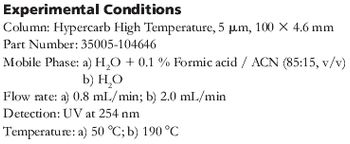
Increased temperature has been used to assist the elimination of organic modifier required in the mobile phase, to achieve analyte separation in pure aqueous mobile phases.
The Application Notebook
Increased temperature has been used to assist the elimination of organic modifier required in the mobile phase, to achieve analyte separation in pure aqueous mobile phases.
The Application Notebook
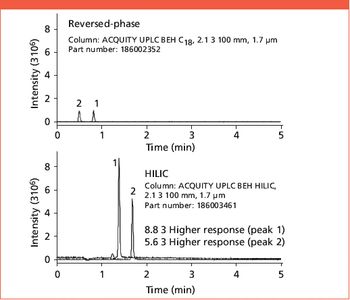
Using HILIC with highly efficient ethylene bridged hybrid (BEH) particles results in faster methods that exhibit improved polar retention, higher sensitivity, enhanced chromatographic resolution, and significantly improved column lifetime.

The Application Notebook
The new reversed-phase ProSwift® 1 mm i.d. column is a divinylbenzene-based monolithic column for routine chromatography of proteins and other biomolecules. It is available in two different lengths. The shorter (1 Ã- 50 mm) format is designed for fast separations and the longer (1 Ã- 250 mm) format is intended for high resolution analytical separations. However, depending on the application, either can be used for separation of proteins and for coupling with mass spectrometry.
The Application Notebook
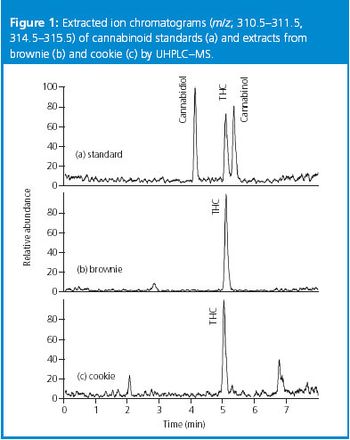
Goal: Positively identify trace amounts of cannabinoids in a complex food matrix quickly, with minimal sample preparation and no chemical derivatization.

The Application Notebook
A highly sensitive analytical method for the analysis of tamsulosin in human plasma has been developed for use in bioanalytical studies. The solid-phase extraction (SPE) and UPLC–MS–MS methodologies are described, as well as performance against validation parameters.
The Application Notebook
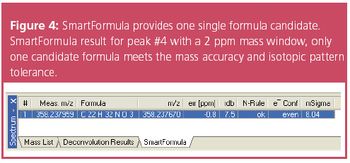
An ultrafast gradient LC separation method was developed to separate a 5-component drug mixture in 30 seconds, with peak widths of 1 second. maXis mass accuracy at sub-ppm levels and true isotopic pattern of the spectra from the peaks lead to a confident elemental formula assignment for each drug compound with the SmartFormula algorithm.
The Application Notebook
The separation and quantitation of drug substances and counterions are two important determinations in the pharmaceutical industry (1). Drug substances and counterions are determined by HPLC (often on reversed-phase columns) and by ion chromatography (IC), respectively. IC is the preferred method for selective and sensitive screening of both cationic and anionic pharmaceutical counterions (2). To increase the analysis throughput, it is desirable that for analysis of drug formulation both drug substance and counterions can be determined within a single run. Naproxen is a non-steroidal anti-inflammatory drug commonly used for treating moderate to severe pain, fever, inflammation, and stiffness. Naproxen sodium was approved by the U.S. Food and Drug Administration (FDA) as an over-the-counter drug. No reports were found describing one technique for the simultaneous determinations of both naproxen and the counterion (Na+).

The Application Notebook
Improve the separation of 14 drugs of abuse in a complex mixture by employing a ternary solvent gradient.

The Application Notebook
Additional studies were undertaken to better understand the chromatographic behavior of PEGylated proteins in an effort to improve purification and characterization techniques of such proteins. Proteins were PEGylated using larger (20 KDa and 40 KDa) PEGylation reagents that are commonly used in pharmaceutical drug development. Generated PEGylated proteins were separated from unmodified proteins using different reversed phase medias (Jupiter® C4 and Jupiter® C18). In these studies it was found that the Jupiter C18 media provided the best separation of PEGylated proteins from their unmodified counterparts. Such results further clarify good method starting points for developing analytical and preparative separations of PEGylated proteins.
The Application Notebook
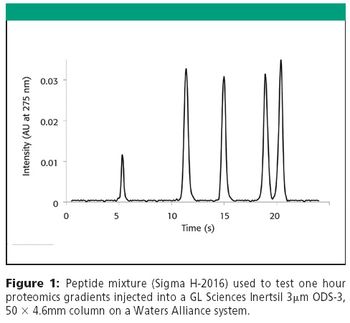
Transforming "standard" gradient HPLC systems into extremely fast gradient systems is readily achievable with proper application of chromatographic principles, particularly temperature control, combined with utilization of advanced HPLC columns. Bottom line: You don't have to buy a new LC to achieve ultra high quality and speed!

The Application Notebook
The recent development of ultra-HPLC (UHPLC) has provided a great potential for high throughput analysis achieved using small (sub-2 μm) particle size columns at increased linear velocities. The advantage of UHPLC over conventional HPLC is increased throughput without sacrificing resolution. Despite their popularity, sub-2 μm particle columns impose practical difficulties, such as high backpressure (which often requires a UHPLC system) and susceptibility to column fouling. Thus difficulty can be overcome using 2.0 to 2.5 μm particles. This study describes an example (analysis of vanilla extract) of transferring a conventional LC method to a high-throughput method using newly developed Acclaim® RSLC 2-μm columns that are based on spherical, porous, high-purity silica particles (dp = 2 μm, pore size = 120 Å, surface area = 320 m2/g).
The Application Notebook
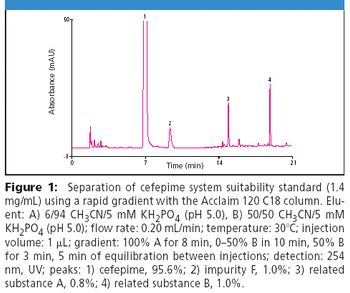
Cephalosporins contain a four-member β-lactam ring that is inherently strained and prone to hydrolysis and photolysis, limiting stability and leading to degradation products that may be toxic (1). In addition, synthetic byproducts are generated and persist during production of these antibiotics including cefepime. Analysis of cefepime purity is particularly challenging due to the presence of such isomeric synthetic impurities. The Acclaim® 120 C18, 3 μm can be used to meet and exceed the criteria set by the USP for determining related substances and assaying the purity of cefepime.
The Application Notebook
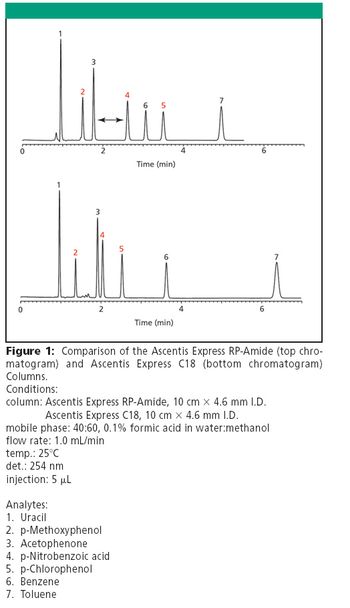
The Fused-Core particle consists of a 1.7 micron solid core and a 0.5 micron porous shell yielding a 2.7 micron diameter. One of the benefits of the Fused-Core particle is the small diffusion path (0.5 microns) compared to conventional fully porous particles. The shorter diffusion path minimizes peak broadening. In fact, there have been many reports on the vast improvements in efficiency provided by Fused-Core particles versus conventional particles. These improvements provide sub-2 micron like performance at half of the backpressure allowing Ascentis Express columns to be used in conventional HPLC as well as UHPLC systems.

The Application Notebook
Recent developments in HRes Fast-LC systems have enabled the use of sub-3 μm stationary phases at higher flow rates and elevated pressures. HRes Fast-LC can provide significant improvements in both resolution and throughput.

The Application Notebook
In size exclusion chromatography, obtaining calibration curves over a wide range of molecular weights is a difficulty investigators often encounter when analyzing polymers with a broad molar mass distribution. To overcome this problem two procedures are typically used. One option is to use multiple columns of different pore sizes linked together in series. A second is to use a column packed with a mixed bed resin of different pore sizes at an optimized mix ratio. However, problems can occur with both of these methods, which include distortion of the chromatogram or deviations between the actual calibration curve and the calibration curve approximated from data obtained from the molecular weight standards.

The Application Notebook
This application note describes a rapid U-HPLC method for the separation of sulphorhodamine 101 (Texas Red®) and its three water-soluble derivatives using a Hypersil GOLD™ column packed with 1.9 μm particles.

The Application Notebook
A new, immobilized chiral stationary phase (CSP) based on a novel chiral selector for HPLC and SFC is described. Its unique selectivity as a complement to Daicel's other commercial immobilized polysaccharide CSPs is demonstrated.

The Application Notebook
This article describes a straightforward ion chromatographic method that uses isocratic elution and pulsed amperometric detection (PAD) to sensitively determine water-soluble polyols and sugar alcohols as well as mono-, di- and oligosaccharides in essential and nonessential foodstuffs. While carbohydrate determination of most foodstuffs requires only minimal sample pretreatment such as dilution and filtration, samples with interfering matrices such as protein-containing dairy products have to be dialyzed prior to injection.

The Application Notebook
Voglibose is an Alpha-Glucosidase inhibitor widely used for the treatment of diabetes. Alpha-glucosidase inhibitors are agents that delay the glucose absorption at the intestinal level and thereby prevent sudden surge of glucose after a meal. Voglibose is the safest and most effective drug of its class.
The Application Notebook
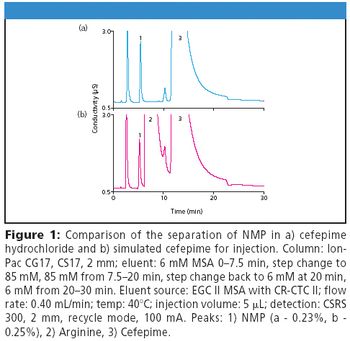
Cefepime is a fourth generation cephalosporin (1). During preparation and storage, cefepime degrades by release of the N-methylpyrrolidine (NMP) side chain and opening of the beta-lactam ring. An NMP concentration increase will directly affect the potency of the active component of the drug. Therefore, it is critical to determine the amount of NMP in cefepime. The US Pharmacopeia (USP) monograph specifies the limit of NMP to <0.3% in cefepime hydrochloride and <1% in cefepime for injection (2,3). The latter is a dry mixture of cefepime hydrochloride and L-arginine. The current USP method uses cation-exchange chromatography with non-suppressed conductivity detection to determine the limit of NMP in cefepime. There are several disadvantages to this method, such as the ~3-4 h time required per injection, a lack of retention time stability for NMP in standard and sample solutions, and a lack of sensitivity. In this paper, we describe an improved method using a hydrophilic, carboxylate-functionalized cation..

The Application Notebook
In general, polymer-based columns have a broad pH range (pH 2 to 13), and some have high temperature tolerance (up to 150°C or higher). Considerably large selectivity changes can be obtained by varying analysis temperature and mobile phase pH. Having control on these two parameters over wide ranges can be especially useful in method development.

The Application Notebook
Paracetamol is a major ingredient in numerous medications due to its analgesic and antipyretic properties. During its synthesis (Figure 1), a total of ten process-related impurities are observed. Several HPLC applications have been developed for the monitoring of these impurities (1, 2), including the European Pharmacopoeia which has adopted an isocratic HPLC method using a silica-based C8 column with 5 μm particle size, requiring a run time of 45 min (3). By using a gradient method and standard HPLC instrumentation, the analysis can be reduced to 7 min (4).
The Application Notebook
A large percentage of commercial and investigational pharmaceutical compounds are enantiomers and many of them show significant enantioselective differences in their pharmacokinetics and pharmacodynamics. The importance of chirality of drugs has been increasingly recognized, and the consequences of using them as racemates or as enantiomers have been frequently discussed in the pharmaceutical literature during recent years. With increasing evidence of problems related to stereoselectivity in drug action, enantioselective analysis by chromatographic methods has become the focus of intensive research of separation scientists. Most of the pharmaceutical and pharmacological studies of stereoselectivity of chiral drugs before the mid eighties involved pre-column derivatization of the enantiomers with chiral reagents forming diastereomers.

The Application Notebook
Traditionally the analysis of water-soluble vitamins by reversed-phase HPLC has been complicated by the lack of retention for these compounds on conventional silica C18 columns. Here we demonstrate efficient, multi-mode, baseline resolution of six water-soluble vitamins in 6 min using a ZirChrom®-SAX column.

The Application Notebook
The analysis of polar compounds in support of clinical and preclinical pharmacokinetic studies requires an analytical methodology capable of achieving ultra-low detection and quantification limits. The high sensitivity afforded by coupling HPLC with tandem mass spectrometry (MS–MS) has made it the technique of choice in this environment, but it is subject to the following limitations when reversed-phase liquid chromatography (RPLC) is used

The Application Notebook
An effective UHPLC–MS method for high throughput separation, identification and quantification of pseudoephedrine was developed on a Hypersil GOLD PFP 1.9 µm, 2.1 Ã- 100 mm column.

The Application Notebook
Several common birth control formulations contain both drospirenone and ethinyl estradiol. A highly selective and sensitive analytical method for the analysis of drospirenone in human plasma has been developed for use in bioequivalence studies. The solid-phase extraction (SPE) and UPLC–MS–MS methodologies are described as well as performance against validation parameters.
The Application Notebook
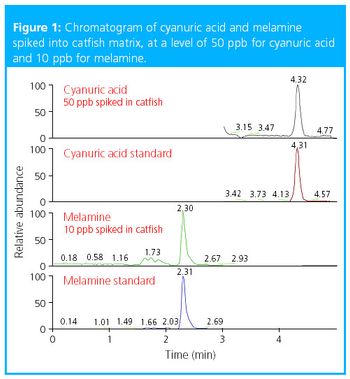
In March 2007, several North American manufacturers of pet food voluntarily issued nationwide recall notices for some of their products that were reportedly associated with renal failure in pets. The raw material wheat gluten, used to manufacture the pet food, was imported from China and was identified as the source of contamination.

The Application Notebook
This application note describes a fast and sensitive LC–MS method using a Hypersil GOLD column on a Thermo Scientific LC–MS system for the quantitative analysis of two widespread PFCs, perfluorooctanoic acid (PFOA) and perfluorooctansulphonate (PFOS).
The Application Notebook
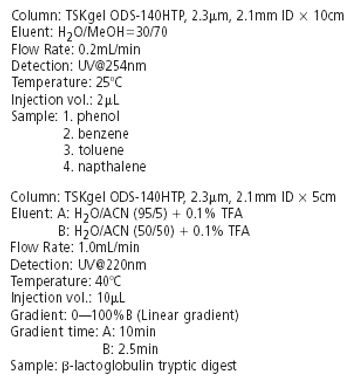
Short analyses time and high resolution are in great demand from R&D and QC departments within the pharmaceutical industry. Sub-two micron ODS reversed phase columns have recently been introduced to meet these requirements, but these columns require an ultra-high pressure HPLC system to achieve optimum performance. TSK-GEL ODS-140HTP, 2.3mm columns from Tosoh Bioscience have been developed to offer a combination of short analyses time and high resolution separations that can be run at modest pressures, making these columns compatible with conventional HPLC instrumentation. The polylayer bonding chemistry of these columns results in highly efficient and physically stable columns when operated at high linear velocities. In addition, TSK-GEL ODS-140HTP, 2.3mm columns can be efficiently operated at pressures not exceeding 9000psi in UPLC® and other ultra-high pressure HPLC systems, as well as in traditional HPLC systems.