Application Notes: LC


Using ACQUITY UPLC technology with triple quadrupole MS detection enhances the selectivity, sensitivity and throughput in quantitative bioanalytical studies. Detection limits for these methods are being driven lower and lower as drugs become more potent.


AC Analytical Controls developed a new chromatographic solution that complies with all ASTM & EN chromatographic test methods listed in biodiesel specifications: the AC all-in-one Biodiesel analyser. Analysis results demonstrate that the AC analyser complies with EN 14103, EN 14105, EN 14106, EN 14110 & ASTM D6584 methods.

The effect of switching between high and low pH mobile phases on a single analytical HPLC column was investigated. The ability to rapidly switch between pH extremes on XBridge columns without special washing/re-equilibration steps dramatically reduces the time for separation of pharmaceutical compounds.

Very low level detection of mycotoxins in the agriculture products has become increasingly important. Mycotoxins are very resistant fungal metabolites that can remain in foods after processing and, sometimes, even after cooking. They are considered potent carcinogens and can be found in many varieties of foods. Of the mycotoxin class, aflatoxins are considered especially harmful, being both acutely and chronically toxic. Aflatoxin B1 and B2 are some of the most potent hepatocarcinogens known. Along with aflatoxins G1 and G2, even extremely low levels of these aflatoxins in the diet are important public-health concerns. With this in mind, this application note describes a specific, robust HPLC method for the low-ppb detection of aflatoxins B1, B2, G1 and G2 in corn.

UltraPerformance LC (UPLC) has been widely accepted by chromatographers because of improvements over HPLC in the sensitivity, resolution and speed of separations. As scientists begin to use this technology for impurity and metabolite profiling, they will need to transfer the methods to preparative LC to isolate and purify their compounds for further research. Therefore, it is necessary to systematically transfer UPLC assays not only to HPLC, but, more importantly, to preparative chromatography. In this application, we provide information on how to scale a UPLC impurity/degradant separation to a preparative LC separation.

Suppressed conductivity detection is a well-developed method for detecting charged species. Reversed-phase high-performance liquid chromatography (RP-HPLC) is a well developed method of separating substances on the basis of hydrophobicity. There are some situations where it is advantageous to use these two methods together. Perfluoro-acids (PFOAs) are one class of compounds that are ionic, hydrophobic and have low UV absorbance and are, therefore, suited to this combination.

The continual increase in sample numbers in busy labs means that it is often difficult for quality control or contract analysis labs to maintain short turnaround times, particularly when instruments are already running at full capacity. To address the need for faster analysis while retaining the quality of separation offered by dedicated amino acid analysers, an improved formulation of sodium citrate based buffers has been developed by Biochrom.

Brian De Borba and Jeffrey S. Rohrer, Dionex Corporation

Bob Wiedemer, Grace Davison Discovery Sciences

The analysis of peptides and additives using a new HPLC innovative column technology, Pathfinder, was shown. For the analysis of flavours in lemon juice GC–MS with a new MS library, FFNSC, with linear retention indices was used.

Soft drink formulas often include preservatives, artificial sweeteners, flavours or caffeine in their list of ingredients. Using the Acclaim OA column, as many as eight common additives may be determined in a single run. Many of these additives are hydrophilic organic acids for which this column was designed. Notably, benzoate and sorbate, which do not resolve on C18 columns at low pH, are fully separated.

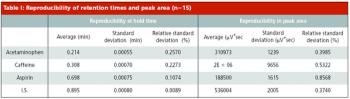
Column lifetime is a more and more important issue when developing an analytical method for HPLC. Besides sample treatment, column cleaning and storage, operational parameters of the analytical method will have an influence on column lifetime. This question may not always be addressed early enough in the methods development process.

Protease inhibitors are a class of anti-HIV drugs used in combination therapy to block replication of the HIV virus in a person's blood. It is important to monitor the levels of these drugs in the patient since resistance can develop at low levels and at high levels the drug can exhibit toxic effects.

Mini application notes summaries

Maltodextrin is an easily digested carbohydrate made from corn starch...

VENTURE A affinity columns utilize ICEtechTM surface passivation technology...

Mini application note summaries...

Polymeric monolithic stationary phases offer an alternative to the classical microparticulate sorbents...

A selection of mini application note write-ups

GC column bleed has been postulated to be caused by "backbiting" of the siloxane chain and volatility of noncrosslinked oligimers...

Phytosterols and stanols (hydrogenated phytosterols) are naturally occurring substances?