Application Notes: LC

i1-601823-1408649293659.jpg

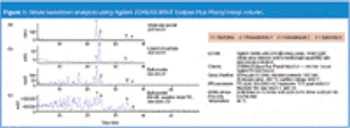
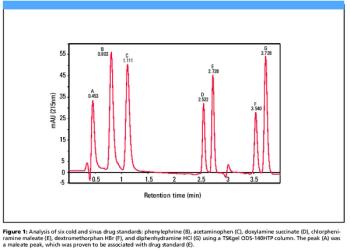
Since the USA Patriot Act* has been enacted, many pharmaceutical companies have reformulated their over the counter (OTC) drug products with phenylephrine (a nasal decongestant) as a substitute for pseudoephedrine. Phenylephrine comes as a tablet, a liquid, or a dissolving strip to take orally - all as a treatment for cold symptoms (1). Besides phenylephrine, most pharmaceutical formulations for common cold and sinus medications often contain multiple active ingredients to treat different types of symptoms in addition to numerous excipients. From an analytical perspective, the challenge is to develop chromatographic conditions that allow quantitative analysis of a variety of excipients that vary widely in hydrophobic properties.

i4-627638-1408644906003.jpg

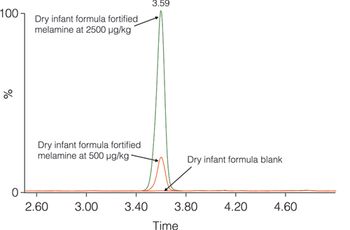
Since September 2008, 294 000 infants and young children suffered urinary problems as a result of the contamination of melamine in infant milk powder and were hospitalized. This hospitalization was required to treat the symptoms caused by the ingestion of melamine contaminated infant formula and related dairy products. Previously in 2007, pet food, animal feed wheat gluten and other protein-based foods were found to contain residues of melamine and its degradation product cyanuric acid.

i4-627679-1408644830388.jpg

Hydrophilic interaction liquid chromatography (HILIC) offers unique advantages for the separation of very polar compounds when compared to reversed-phase chromatography. A new silica based HILIC phase was developed to provide additional selectivity options in HILIC separations. The separation of water soluble vitamins on the new TSKgel NH2-100 HILIC column and on the well known TSKgel Amide-80 HILIC column demonstrates the differences in selectivity.

i1-627629-1408644933230.jpg

Forensic laboratories face a daunting task to identify trace amounts of controlled substances in small samples of seized evidence. Unambiguous identification is required to meet the stiff challenge that is sure to be raised in the courtroom. Positive proof is especially difficult to establish if the controlled substance is hidden in a complex food matrix with a high content of sugars, fats, fatty acids, proteins and alkaloids.

i1-627642-1417781016914.jpg

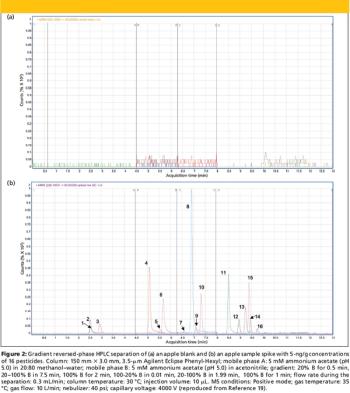
Penicillins are regulated substances in food for human consumption. The minimum residue limits range from 1 ng/g to as high as 50 ng/g depending on the compound. Because of the complexity of food matrices measuring the level of contaminants requires a total solution composed of sample extraction, sample clean-up, chromatographic separation and detection. In this paper, a solid-phase extraction method with a high performance liquid chromatography tandem mass spectrometry method (HPLC–MS–MS) is shown for the simultaneous determination of six antibiotic residues.

i1-581382-1417779111763.jpg

Phenols are frequently present in water because of their widespread use in commercial products and because they are by-products of processes in petrochemical, pulp and paper, plastic, and glue manufacturing industries (1,2). The concentration of phenolic compounds in the waste discharges can be as high as 20 mg/L (2); however, phenol-containing pesticides and wood preservatives may cause significant health hazards even at mg/L levels (1). Consequently, it is important to monitor phenols and substituted phenols in environmental and biological samples. Liquid chromatography with electrochemical detection is one of the widely used methods due to its high selectivity and sensitivity for phenolic compounds. However, glassy carbon working electrodes, used in the electrochemical detection of phenols, often require polishing (3). This time-consuming and often poorly reproducible polishing can be avoided with disposable carbon electrodes, which offer comparable or better analytical performance (4).

i2-581402-1408660976586.gif

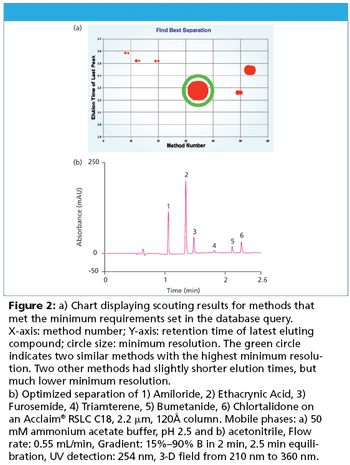
In HPLC method development, screening of various para-meters such as stationary phase, eluents, and temperatures is conducted to find optimal resolution. However, method development can be a time consuming and inefficient process. UHPLC technology can be applied to significantly shorten both the analysis and development times. Here we describe an integrated and ultrafast automated method scouting solution that provides fast and efficient method development processes.

i2-581401-1408660980260.gif

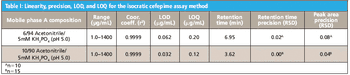
Development of cephalosporin antibiotics has led to compounds with a broad spectrum of activity against both Gram-positive and Gram-negative bacteria with low toxicity profiles. Cefepime, a fourth-generation cephalosporin, is a commonly prescribed broad spectrum antibiotic with improved activity against Gram-negative bacteria compared to other commercially available cephalosporins (1). Despite extensive research on this class of drugs, quantitative analysis and purity assays remain problematic (2).

i1-581380-1408661069036.jpg

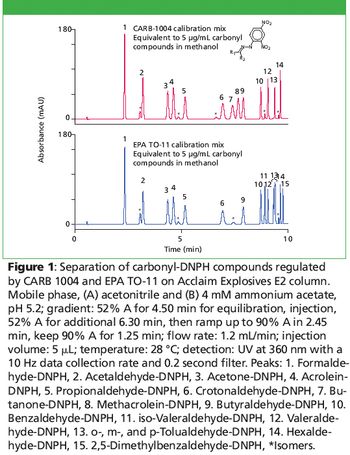
Carbonyl compounds, including low molecular weight aldehydes and ketones, have environmental and health concerns; for example, short-term exposure to aldehydes can irritate the eyes, skin, and upper respiratory tract. Motor vehicles emit reactive hydrocarbons that undergo photochemical oxidation in the atmosphere, which generates formaldehyde and other carbonyls. In addition, formaldehyde contributes to the formation of photochemical ozone. California Air Resources Board (CARB) Method 1004 (1) provides an analytical method for the automotive industry to monitor 13 carbonyl compounds in engine exhaust. US EPA Method TO-11A (2) and Method 8315 (3) monitor atmospheric formaldehyde and 14 other carbonyl compounds and are used for a variety of environmental and occupational health purposes. In these methods, carbonyl compounds are trapped as the dinitrophenylhydrazine (DNPH) derivatives before analysis by HPLC.

i1-581375-1408661088872.jpg

The new reversed-phase ProSwift® 1 mm i.d. column is a divinylbenzene-based monolithic column for routine chromatography of proteins and other biomolecules. It is available in two different lengths. The shorter (1 Ã- 50 mm) format is designed for fast separations and the longer (1 Ã- 250 mm) format is intended for high resolution analytical separations. However, depending on the application, either can be used for separation of proteins and for coupling with mass spectrometry.

i4-582481-1408659433958.jpg

An ultrafast gradient LC separation method was developed to separate a 5-component drug mixture in 30 seconds, with peak widths of 1 second. maXis mass accuracy at sub-ppm levels and true isotopic pattern of the spectra from the peaks lead to a confident elemental formula assignment for each drug compound with the SmartFormula algorithm.

i1-575612-1408667185836.jpg

The separation and quantitation of drug substances and counterions are two important determinations in the pharmaceutical industry (1). Drug substances and counterions are determined by HPLC (often on reversed-phase columns) and by ion chromatography (IC), respectively. IC is the preferred method for selective and sensitive screening of both cationic and anionic pharmaceutical counterions (2). To increase the analysis throughput, it is desirable that for analysis of drug formulation both drug substance and counterions can be determined within a single run. Naproxen is a non-steroidal anti-inflammatory drug commonly used for treating moderate to severe pain, fever, inflammation, and stiffness. Naproxen sodium was approved by the U.S. Food and Drug Administration (FDA) as an over-the-counter drug. No reports were found describing one technique for the simultaneous determinations of both naproxen and the counterion (Na+).

i4-575584-1408667320652.jpg

Additional studies were undertaken to better understand the chromatographic behavior of PEGylated proteins in an effort to improve purification and characterization techniques of such proteins. Proteins were PEGylated using larger (20 KDa and 40 KDa) PEGylation reagents that are commonly used in pharmaceutical drug development. Generated PEGylated proteins were separated from unmodified proteins using different reversed phase medias (Jupiter® C4 and Jupiter® C18). In these studies it was found that the Jupiter C18 media provided the best separation of PEGylated proteins from their unmodified counterparts. Such results further clarify good method starting points for developing analytical and preparative separations of PEGylated proteins.

i3-575600-1408667229025.gif

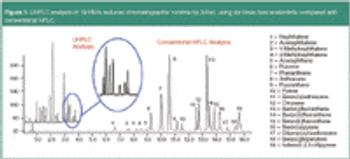
The recent development of ultra-HPLC (UHPLC) has provided a great potential for high throughput analysis achieved using small (sub-2 μm) particle size columns at increased linear velocities. The advantage of UHPLC over conventional HPLC is increased throughput without sacrificing resolution. Despite their popularity, sub-2 μm particle columns impose practical difficulties, such as high backpressure (which often requires a UHPLC system) and susceptibility to column fouling. Thus difficulty can be overcome using 2.0 to 2.5 μm particles. This study describes an example (analysis of vanilla extract) of transferring a conventional LC method to a high-throughput method using newly developed Acclaim® RSLC 2-μm columns that are based on spherical, porous, high-purity silica particles (dp = 2 μm, pore size = 120 Å, surface area = 320 m2/g).

i1-575611-1408667188103.jpg

Cephalosporins contain a four-member β-lactam ring that is inherently strained and prone to hydrolysis and photolysis, limiting stability and leading to degradation products that may be toxic (1). In addition, synthetic byproducts are generated and persist during production of these antibiotics including cefepime. Analysis of cefepime purity is particularly challenging due to the presence of such isomeric synthetic impurities. The Acclaim® 120 C18, 3 μm can be used to meet and exceed the criteria set by the USP for determining related substances and assaying the purity of cefepime.

i1-575623-1408667158070.jpg

The Fused-Core particle consists of a 1.7 micron solid core and a 0.5 micron porous shell yielding a 2.7 micron diameter. One of the benefits of the Fused-Core particle is the small diffusion path (0.5 microns) compared to conventional fully porous particles. The shorter diffusion path minimizes peak broadening. In fact, there have been many reports on the vast improvements in efficiency provided by Fused-Core particles versus conventional particles. These improvements provide sub-2 micron like performance at half of the backpressure allowing Ascentis Express columns to be used in conventional HPLC as well as UHPLC systems.

i2-575604-1408667207725.gif

Recent developments in HRes Fast-LC systems have enabled the use of sub-3 μm stationary phases at higher flow rates and elevated pressures. HRes Fast-LC can provide significant improvements in both resolution and throughput.

i4-575626-1408667151067.jpg

In size exclusion chromatography, obtaining calibration curves over a wide range of molecular weights is a difficulty investigators often encounter when analyzing polymers with a broad molar mass distribution. To overcome this problem two procedures are typically used. One option is to use multiple columns of different pore sizes linked together in series. A second is to use a column packed with a mixed bed resin of different pore sizes at an optimized mix ratio. However, problems can occur with both of these methods, which include distortion of the chromatogram or deviations between the actual calibration curve and the calibration curve approximated from data obtained from the molecular weight standards.

i2-575585-1408667317127.gif

This application note describes a rapid U-HPLC method for the separation of sulphorhodamine 101 (Texas Red®) and its three water-soluble derivatives using a Hypersil GOLD™ column packed with 1.9 μm particles.

i4-575603-1408667211448.gif

This article describes a straightforward ion chromatographic method that uses isocratic elution and pulsed amperometric detection (PAD) to sensitively determine water-soluble polyols and sugar alcohols as well as mono-, di- and oligosaccharides in essential and nonessential foodstuffs. While carbohydrate determination of most foodstuffs requires only minimal sample pretreatment such as dilution and filtration, samples with interfering matrices such as protein-containing dairy products have to be dialyzed prior to injection.