All News

I do not remember the application, but I remember very clearly Professor McNair telling us that soil is one of the most challenging sample matrices, if not the toughest, from which to perform analytical determinations. Sources indicate the composition of soil ideal for growing plants to be 25% air, 25% water, 45% minerals, and 5% organic matter. That does not seem like a daunting makeup, but the reality is that the relative proportion of the constituents can vary dramatically.

The overriding majority of articles on problems with the technical transfer of HPLC methods ultimately focus on differences between HPLC dwell volumes. However, as the title suggests, there are many more issues which can cause problems in the transfer of HPLC methods, and I wanted to highlight some common issues that come across my desk, in the hope that it will help you avoid these problems in your own practice.

Several years ago, I would have held the stance that environmental analysis was fairly boring. How complicated can water be? I am not ashamed to say that was a naïve view. It is clear from our research and related research by others on similar topics that much more work in these areas is needed. Standard methods cannot solely accommodate the growing list of targets and the multitude of unknowns associated with complex samples taken from the interface between the petroleum industry and the environment.

LCGC2_i1.gif

Novel ionization processes provide gas-phase ions of a wide variety of materials using MS. These simple and sensitive methods operate from solution or a solid matrix. Both manual and automated platforms are described that allow rapid switching between the ionization methods of MAI, SAI, vSAI, and conventional ESI.

LCGC3_i1.gif

A fully automated process for online peak fractionation and reduction of therapeutic antibodies with subsequent QTOF-MS characterization is presented. The technique is based on state-of-the-art 2D-HPLC technology coupled with additional HPLC modules via a dedicated software macro.

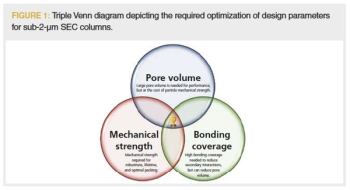
An excerpt from LCGC’s e-learning tutorial on optimizing size-exclusion chromatography (SEC) for biologics analysis at CHROMacademy.com

figure 1 L.png

The last decade has witnessed how liquid chromatography columns and instruments changed from long bulky columns with relatively large fully porous particles operated at modest pressures (100Ð200 bar), to short compact columns with small superficially porous particles operated at ultrahigh pressures (1200Ð1500 bar). This (r)evolution has resulted in a tremendous increase in achievable separation performance or decrease in analysis time, but requires a good knowledge of optimal chromatographic conditions for each separation problem and, concomitant, the right instrument configuration.

Table 1 S1520265273500.png

Gas chromatography makes use of a wide variety of detection methods. In addition to the most often used flame-ionization detection (FID), electron-capture detection (ECD), thermal conductivity detection (TCD), and mass-selective detection (MSD), the list of other detection methods is long. They really shine when deployed properly, but their properties and applications can be a bewildering alphabet soup. This instalment presents a compendium of gas chromatography (GC) detection methods, both past and vanished as well as those that are current and relevant to today’s separation challenges.