
Sponsored Content
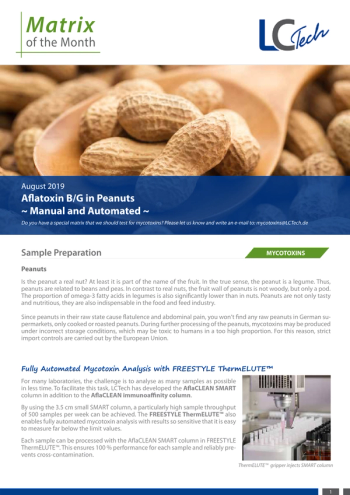
See how mycotoxin sample preparation in peanuts can be faster and more efficient with manual or automated workflows, high recoveries and time saving.
Sponsored Content
See how mycotoxin sample preparation in peanuts can be faster and more efficient with manual or automated workflows, high recoveries and time saving.

Sponsored Content
GC-FID enables fast, reproducible analysis of 37 FAMEs in edible oils, improving fatty acid profiling for quality, authenticity, and adulteration detection.
Sponsored Content
GC-FID enables accurate benzene analysis in USP Carbomer 940, meeting system suitability and supporting compliant pharmaceutical quality control workflows.
Sponsored Content
Analyze residual solvents in flexible food packaging with GC 2400 and HS 2400 M, delivering accurate, compliant results and no carryover.
Sponsored Content
Effluent wastewater testing is essential for protecting human health and the environment, and EPA Method 624.1 is a widely used approach for monitoring volatile organic compounds (VOCs) in water. This application note demonstrates how the combination of the Teledyne LABS Tekmar Lumin Purge & Trap (P&T) concentrator, AQUATek LVA autosampler, and PerkinElmer GCMS 2400 platform delivers accurate, reliable, and highly sensitive VOC analysis while effectively managing water vapor transfer that can compromise GC/MS performance.
Sponsored Content
Dibenzyl disulfide (DBDS) is a corrosive sulfur compound that can accelerate copper sulfide formation in transformers, increasing the risk of insulation damage and equipment failure. Routine monitoring of DBDS is therefore critical for transformer health, regulatory compliance, and preventive maintenance. This application note demonstrates how the PerkinElmer GC 2400 System with Electron Capture Detection (ECD) provides a sensitive, reliable, and cost-effective approach for DBDS analysis in transformer oils, delivering excellent linearity, precision, and freedom from carryover in accordance with IEC 62697 guidelines.
Selecting the right LC system is a strategic decision. The right choice depends on your samples, purification goals, detection needs, throughput, workflow complexity, available lab space, and plans for future growth. BUCHI’s Liquid Chromatography Buyer’s Guide helps you evaluate these factors clearly, so you can choose your next system with confidence. Inside the guide: Five steps to identify your purification pathway Guidance on matching system capability to workflow needs Considerations for flash chromatography and prep HPLC Decision tree to help determine which system is the best fit The guide introduces two BUCHI chromatography system families: Pure Essential: designed for basic flash applications and first steps into automated chromatography. Pure Excellence: BUCHI’s flagship liquid chromatography system family for high-performance purification.
BUCHI continues to drive innovation in chromatography. To help you unlock brilliance in your lab, BUCHI launched the Pure Excellence Chromatography System, a new flash (and optional prep HPLC) instrument designed for ease of use, advanced precision, and enhanced safety. Curious to know how you can improve high-performance purifications? Join BUCHI specialists, Alina Gau and Birke Götz, as they showcase how the new Pure Excellence Chromatography System simplifies your pharma and chemistry R&D workflows.
The product portfolio includes the C-905, C-910, and C-915 for flash applications, offering flexible detection options, including ELSD. The C-950 further expands application capabilities by integrating prep HPLC, providing added versatility for laboratories with advanced purification requirements.Building on BUCHI’s long-standing reputation for reliability and innovation, the Pure Excellence Chromatography Systems combine user-friendly operation with high separation performance. Key features include: A quick-release cartridge holder enabling secure, one-handed cartridge installation to simplify daily operation. Automated and manual sample injection modes supporting both liquid injection and solid sample loading for improved reproducibility and time efficiency. A high-performance pump with a three-piston design ensures pulse-free flow. Evaporative Light Scattering Detection (ELSD) offers near-maintenance-free operation and high detection accuracy through patented direct nano-pulse injection technology. Four-solvent gradient capability expands method development flexibility and simplifies challenging separations. Advanced safety features, including continuous system monitoring, active ventilation with a closed fraction collector (enabling operation outside a fume hood), and RFID-based fraction collector rack identification. Intuitive software with method/run preview, simplified gradient editing, and always visible run monitoring supports faster, more consistent purification. With a focus on simplicity, performance, and safety, the Pure Excellence Chromatography Systems enable laboratories to achieve purification goals faster and with greater confidence.
See how the Pure Excellence Chromatography System makes purification faster, safer, and easier than ever. In this product demo, we walk through every step of running a chromatographic separation, from priming the solvent lines to collecting your final fractions.
This study investigates the separation of egg white proteins using flash and prep HPLC with silica stationary phases varying in pore and particle sizes. Larger pore sizes improved protein interaction with the stationary phase, while particles above 10 µm were ineffective. Optimal separation was achieved using the Pure Excellence C-950 with a PrepPure C18WP column, combining wide pores, small particles, and a step gradient.
Sponsored Content
Comprehensive characterization of biotherapeutics requires advanced analytical strategies capable of detecting and identifying low-abundant product quality attributes (PQAs), including post-translational modifications, aggregates, sequence variants, and conjugation sites. This eBook presents three technical articles demonstrating advanced LC-MS workflows that achieve up to 10X improvement in MS sensitivity for trace-level detection and confident identification of these challenging attributes.
Discover a next generation laboratory balance designed for connected, automated environments. This article explains how network ready weighing technology supports regulatory compliance, digital workflows, and seamless integration into robotics and lab IT systems, enabling smarter data handling and more efficient, reproducible laboratory processes.
This white paper summarizes harmonized pharmacopeial requirements for analytical balances across USP, Ph.Eur., JP, and ChP. It explains regulatory timelines, calibration and performance check expectations, environmental control recommendations, and practical guidance for meeting accuracy and repeatability criteria in pharmaceutical quality control laboratories.
Sponsored Content
This note applies the EPA 1633 workflow to fish and animal tissues, enabling sensitive, low‑level PFAS detection using automated SPE and LC/MS/MS. The dual‑layer SPE design improves efficiency and recovery, meeting all EPA performance criteria across complex tissue matrices.
Sponsored Content
In food safety testing, instrument reliability under real-world conditions is the true test of performance. This technical note showcases the durability and consistency of the PerkinElmer QSight® 500 LC/MS/MS system through an intensive robustness study, analyzing high-matrix food samples with minimal cleanup and no loss in sensitivity. Using a simplified QuEChERS extraction (no SPE), the system successfully analyzed PFAS analytes across complex matrices like salmon, avocado, pet food, and spices. The results highlight not only long-term stability but also the power of StayClean™ technology to reduce downtime and keep throughput high.
Sponsored Content
This application note describes a fast and robust LC‑MS/MS method for honey authenticity testing by targeted quantification of 3‑methoxytyramine, a specific marker for beet‑sugar feeding. Using the QSight® 500 LC‑MS/MS with EDIT‑ESI and a simplified Blend‑and‑Inject workflow, the method eliminates SPE and isotopically labeled internal standards while delivering high sensitivity, excellent reproducibility, and high throughput for routine commercial and regulatory honey testing.
Sponsored Content
This application note presents a simplified Blend‑and‑Inject LC‑MS/MS method for the quantification of 25 PFAS compounds in animal‑derived food matrices using the QSight® 500 LC‑MS/MS system. By eliminating SPE and leveraging matrix‑matched calibration, isotopically labeled standards, and a PFAS delay column, the method achieves EU‑compliant sensitivity and robust performance in complex tissues, enabling high‑throughput and reliable PFAS monitoring for food safety compliance.
Learn how water quality, handling, purification technologies, final filters, and maintenance practices help ensure optimal LC-MS performance and reliability
Sponsored Content
Measure ethylene oxide and other air toxics using US EPA Method 327, achieving 10 ppt detection limits without liquid cryogen.
Sponsored Content
Methodology for assessing PFAS emissions from food contact materials under typical usage conditions using dynamic headspace sampling and TD-GC-MS/MS.
Sponsored Content
Understand the consumer aroma experience of fragrance-release products with automated time-resolved VOC sampling
Sponsored Content
Automated pairwise chromatogram comparison identifies key differences between GC-MS and GC×GC-MS data in minutes, simplifying data processing and reporting.
Sponsored Content
Large-volume extraction with TD-GC-MS enables reproducible, mass-based measurement of microplastics across wastewater treatment stages.
Sponsored Content
Enhance SPME sensitivity using multi-step enrichment for improved VOC and SVOC profiling and more effective short-duration sampling.
Sponsored Content
BioAccord LC-MS System with ACQUITY Premier - Product Brochure
Optimizing sample preparation is critical for generating high-quality, reproducible analytical data, particularly when working with complex matrices. Yet, it often demands significant time and effort. Traditional methods, including solid phase extraction (SPE), supported liquid extraction (SLE), filtration, and nucleic acid (NA) extraction, rely on column- or plate-based protocols and can face limitations in throughput, reproducibility, and the handling of difficult samples. Conventional approaches such as centrifugation and vacuum manifolds introduce further challenges, from added manual intervention and inconsistent flow to difficulty processing viscous samples. Positive pressure instrumentation uses controlled gas flow to push liquids through columns or plates, maintaining constant pressure across all positions to improve analyte recovery, reduce matrix effects, and support automation. This whitepaper examines how positive pressure compares to conventional methods and how Tecan's Resolvex platforms apply the technology across manual, semi-automated, and fully automated workflows.
See how IC-ICP-MS differentiates Cr(III) and Cr(VI) in water with reliable separation, sensitive detection, and streamlined software control.
This application note explores the use of positive pressure processing for plasmid DNA extraction by automating key preparation steps in a large-volume purification workflow. Performed in a compact benchtop format, this automated approach helps improve consistency, reduce hands-on time and streamline plasmid DNA purification for molecular biology and genomics applications.
This application note demonstrates an automated workflow for the analysis of trypsin-digested bovine serum albumin (BSA), combining on-column digestion and peptide clean-up using solid phase extraction (SPE) within a single column. Using automated positive pressure processing, the workflow streamlines sample preparation, reduces hands-on time and delivers consistent, reproducible peptide recovery for downstream analysis.